
A Strategic Guide to Show Notes for Podcast Growth


You recorded a great podcast episode. Now, how do people find it? The answer is your podcast show notes.
Show notes are the text-based companion to your audio. They act as a bridge between your voice and new listeners. Think of them as the landing page for each episode, making your content searchable, scannable, and valuable.
What Are Podcast Show Notes?
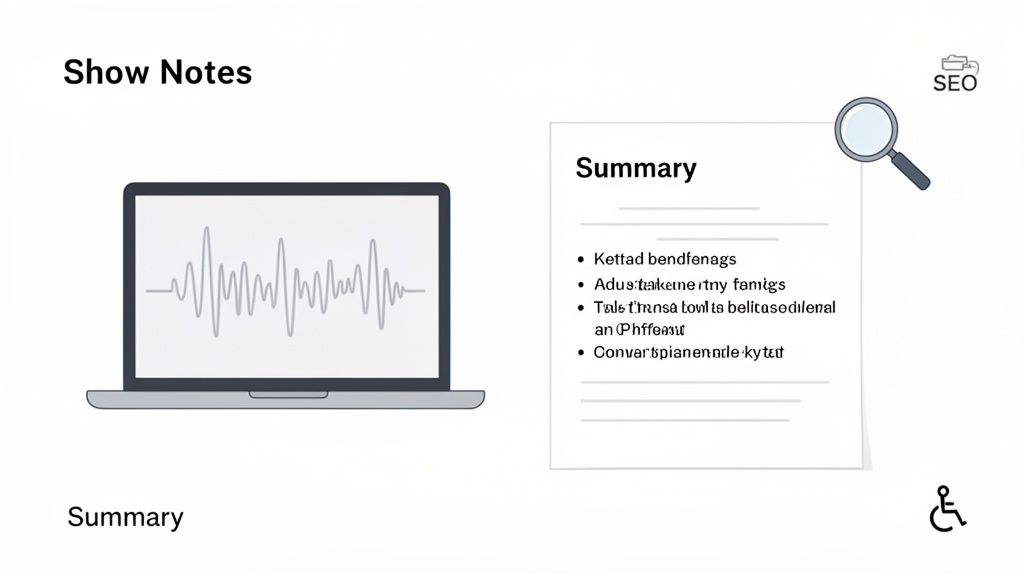
Podcast show notes are a written overview of your audio episode. They are published alongside the media player on your website or podcasting app. Effective show notes are a tool designed to attract new listeners and give your current audience a better experience.
Show notes are different from a full transcript. A transcript for podcast is a complete word-for-word record. Show notes are curated. They highlight key takeaways, important moments, and relevant links in an easy-to-read format.
This distinction is critical. Search engines like Google read text, not audio. Without text, your podcast is invisible to anyone searching for the topics you discuss.
Why They Matter for Growth
For any podcaster serious about growth, quality show notes are essential. This is how modern audiences discover what to listen to. A busy professional won't commit 45 minutes to an episode, but they can scan your show notes in 60 seconds to judge its value.
This single asset helps you achieve four key goals:
- Boost SEO: Make your audio content visible to search engines.
- Improve Accessibility: Serve audience members who are hearing-impaired or prefer reading.
- Enhance Listener Experience: Provide timestamps and links to all mentioned resources.
- Simplify Content Repurposing: Create a foundation for blog posts, social media, and newsletters.
Bottom line: Show notes transform your audio from a closed file into an open, searchable asset. They are the most effective way to connect your spoken content to search engine queries.
Detailed show notes respect your audience's time. You give them multiple ways to engage with your content. Whether a listener wants to jump to a specific topic or find a guest's website, your notes make it possible.
The Four Pillars of Great Show Notes
Effective show notes are more than an episode summary. They are a strategic growth engine. When done right, you turn a simple document into a powerful asset that attracts new listeners and retains your current audience.
This strategy is built on four core pillars. Each has a specific function, but they work together to expand your podcast's reach.
Pillar 1: Get Found with SEO and Discoverability
This is the most important reason to create show notes. Search engines cannot listen to your audio files. They rely entirely on text to understand your episode's topic and audience.
Your show notes are the key to organic discovery. Without them, the insights you share are invisible to millions of people searching for that information. Well-written notes with the right keywords make your audio searchable.
Pillar 2: Open Your Doors with Accessibility
Your audience is diverse. Not everyone can or wants to listen to audio. High-quality show notes make your podcast accessible to a much wider group.
This is a critical advantage for key audiences:
- The Deaf and Hard-of-Hearing: Detailed notes or a summary provide an equivalent experience.
- Non-Native Speakers: Following along with text improves comprehension for listeners still mastering the language.
- People in Loud Environments: Reading a quick summary is more practical than listening on a noisy train or in a busy office.
By offering a text version, you show a commitment to inclusivity. You ensure anyone interested can engage with your work.
Pillar 3: Elevate the Listener Experience
For your existing audience, show notes respect their time. They turn passive listening into an active, efficient experience. A busy professional can scan your notes in 30 seconds to find the most relevant segment.
Think of your show notes as a detailed table of contents for your audio. You give listeners the power to jump straight to the most valuable sections.
Key features that boost the experience:
- Clickable Timestamps: Allow users to skip directly to a specific question or topic.
- Resource Links: Provide easy access to books, tools, or guest websites you mentioned.
- Key Takeaways: Offer a bulleted list of the biggest insights for a quick refresher or for sharing.
Pillar 4: Multiply Your Content with Repurposing
Creating fresh content is time-consuming. Your show notes are a goldmine for repurposing. They allow you to extract maximum value from each episode with minimal extra effort.
From one set of detailed show notes, you can create:
- A full-length blog post.
- A week of social media posts for Twitter or LinkedIn.
- An engaging email newsletter.
- A script for a short video on TikTok or YouTube Shorts.
This approach saves time and ensures your core message reaches your audience on multiple channels.
How to Structure Show Notes for Maximum Engagement
Structure your show notes like a roadmap for your listener. People are busy and they scan content. A smart structure turns a wall of text into a useful resource that directs them to the best parts quickly.
Consistency is key. When your audience knows what to expect, they will rely on your show notes, building trust and engagement with every episode.
The Essential Opening
This is your first impression. You have seconds to convince someone the episode is worth their time.
- SEO-Optimized Title: Your title must be compelling for humans and optimized for search engines. Avoid generic titles like "Episode 54." Instead, use "Episode 54: Mastering Angel Investment with Jane Doe."
- Concise Episode Summary: This is your elevator pitch. In just 2-4 sentences, state the core problem you solve or the episode's main takeaway. Be direct and focus on value.
The Core Content Body
This section delivers the value. The goal is to make it easy for someone to scan and find what they need without scrubbing through the audio.
- Bulleted Key Takeaways: Extract the top 3-5 most important insights. Use bold text to highlight the core message of each point. This is often the most-read part of any show notes.
- Timestamped Outline: Break the episode into its main segments and add clickable timestamps. This shows respect for your listener's time by letting them jump straight to the parts that matter most.
A well-organized, timestamped outline is the ultimate user experience feature. It transforms passive listening into an active, self-directed session.
- Mentioned Resources and Links: Create a clean list of every book, tool, article, or person you mentioned. This is a massive value-add for your listeners.
The Closing Action
You've provided great content—now tell them what to do next. Guide your listener toward the next logical step.
- Clear Call-to-Action (CTA): What is the one thing you want them to do? Subscribe to the podcast? Join your newsletter? Be direct and make the request clear.
- Guest Information: If you had a guest, feature them here. Include a short bio, their website, and social media links. This is a great way to thank your guest and connect your audience. For a deeper dive, learn more about creating a powerful podcast transcript to executive summary to fuel your content strategy.
Advanced SEO Strategies for Your Show Notes
Basic show notes get you in the game. Advanced SEO helps you win it. This is how you turn a simple summary into a long-term asset that drives organic traffic.
Stop thinking like a podcaster and start thinking like a search strategist. Your goal is to match your episode's content with the exact phrases your ideal listeners are searching for.
Effective keyword research is not optional. Use free tools like Google Keyword Planner or paid options like Ahrefs to find what your audience is searching for. Target specific, long-tail keywords like “angel investing tips for SaaS startups,” not just broad terms.
Strategic Keyword Placement
Once you have your keywords, where you place them matters. Weave them naturally into the parts of your show notes that search engines prioritize.
Focus on these high-impact locations:
- Episode Title (H1): Your main keyword must be here.
- H2/H3 Subheadings: Use secondary keywords in subheadings to create a clear outline for search engines.
- Opening Summary: Place your primary keyword within the first 100 words.
- Image Alt Text: Describe images with relevant keywords for another ranking signal.
Deliberate keyword placement helps search engine crawlers understand and rank your content effectively.
Building Authority with Internal Linking
Good SEO requires an ecosystem of content that proves your expertise. Internal linking is your secret weapon for building "topical authority."
When you publish a new episode, find older, related episodes or blog posts on your site and link to them. For example, if your new episode covers marketing funnels, link back to a previous interview with a copywriting expert.
This simple tactic achieves two things. First, it keeps visitors on your site longer, which is a positive signal to Google. Second, it shows search engines you have deep content on a specific topic, establishing you as an authority.
Streamlining Your Workflow with AI and Automation
Creating detailed show notes is time-consuming. It's often the biggest bottleneck in a podcaster's workflow. The process of re-listening, transcribing, and summarizing audio takes hours. Automation is a game-changer.
Manually crafting show notes for every episode consumes time you could use to record, find guests, or connect with your audience. In a crowded market, inefficiency holds you back.
The Power of an AI-Driven Approach
The podcasting world is massive, with over 3.5 million shows competing for attention. Your most precious resource is not your microphone—it's your time. AI tools that distill your long-form audio into concise summaries are essential for staying competitive.
This is what a smart, SEO-focused workflow looks like.
It starts with understanding audience search intent and ends with building authority by linking to your other relevant content.
An AI-first approach frees you to focus on strategy—like keyword research and promotion—while the grunt work is automated. It is the fastest way to get from a raw audio file to a published, optimized article.
How PodBrief Accelerates Show Note Creation
PodBrief was built to solve this exact problem. It acts as your personal AI assistant, turning hours of audio into a structured, accurate brief in minutes. This brief is the perfect foundation for your final show notes.
PodBrief takes your raw audio and delivers a concise, actionable summary. It extracts key ideas, identifies main takeaways, and organizes them into a structured brief.
Instead of manually scrubbing through recordings, you get a clean document ready for your template. Just upload your episode, let the AI work, and then format the output. You can learn more about this technology in our guide to the best AI for podcasters.
This workflow enables consistent production of high-quality show notes without the hours-long time commitment. Reclaim your schedule to focus on creating an amazing show.
Real-World Examples of Great Podcast Show Notes
Theory is useful, but seeing professional examples provides real-world learning. Let's analyze a top-tier podcast to see what great show notes look like. They understand that their notes are often the first chance to capture a potential listener.
We will break down the approach of a show that excels at this. They know their audience is busy, so they deliver immense value in a clean, scannable format.
How I Built This with Guy Raz
The team behind NPR's How I Built This has mastered creating detailed, user-friendly show notes. It is a perfect case study in giving an audience what they need without overwhelming them.
Look at how they structure a typical episode page.
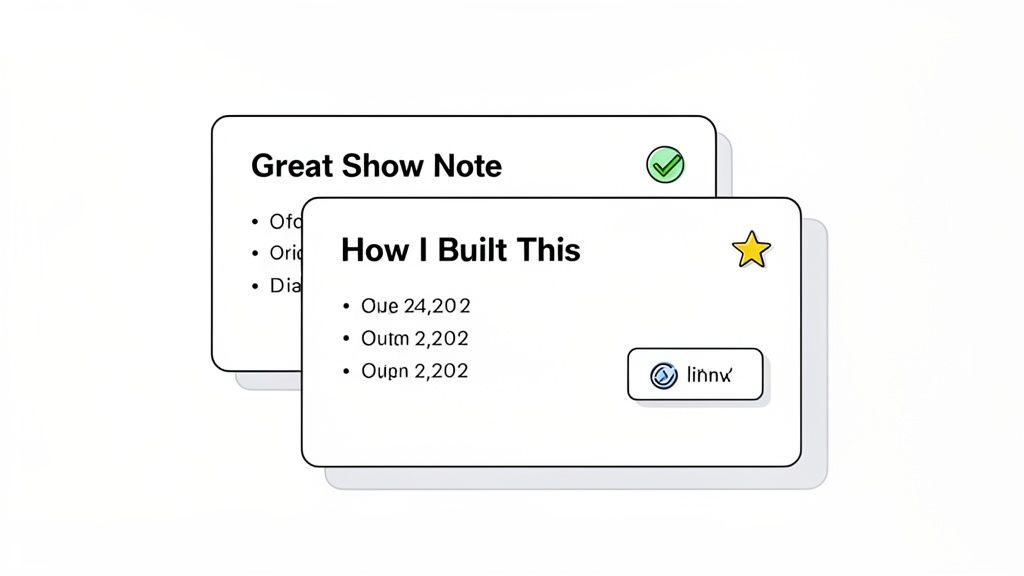
A powerful, descriptive summary immediately hooks the reader. Below that, the audio player and a link to the full transcript are impossible to miss.
Their approach is simple but brilliant: they give people options. One person might want a quick summary, another might want to read the entire conversation, and a third just wants to press play. How I Built This makes all three paths obvious and effortless. It is a masterclass in user-centric design.
Here’s what makes their show notes for podcast episodes so effective:
- Compelling Summaries: They use a tight paragraph to introduce the guest, the story, and why it is worth your time.
- Clear Calls-to-Action: Large buttons to listen on different platforms eliminate guesswork.
- Full Transcript Access: Offering a full transcript is a major win for accessibility and for listeners seeking specific quotes.
This structure works because it is built for the user. It guides someone smoothly from discovery to listening. By focusing on a clean layout and providing instant value, your show notes can achieve the same result.
FAQs on Show Notes
Let's address common questions podcasters have about show notes. Getting these answers right will improve your workflow and your podcast's growth.
How Long Should My Show Notes Be?
There is no magic number, but aim for at least 300 words. This provides enough substance for search engines to understand your episode's topic and begin ranking it for relevant searches.
Quality always trumps quantity. A well-structured, 300-word summary with key takeaways, timestamps, and links is more valuable than a 1,000-word wall of text. The goal is clear, scannable information that respects the user's time.
Where Do I Put My Show Notes?
Post your show notes in two main places for maximum impact.
First, and most importantly, publish them on your podcast's website. Each episode should have its own blog post. This is your SEO powerhouse, giving you full control over formatting and internal linking.
Second, paste them into the episode description field in your podcast hosting platform (like Libsyn or Buzzsprout). This makes your notes appear directly within podcast apps like Apple Podcasts and Spotify.
What’s the Difference Between Show Notes and a Transcript?
The distinction is straightforward: show notes are a summary, while a transcript is the full, word-for-word text.
- Show Notes: These are the "CliffsNotes" for your episode. They are a curated guide to the main ideas, guest details, and important links. They are designed to be scanned quickly.
- Transcript: This is the entire verbatim script of your episode. Transcripts are excellent for accessibility and for listeners who want to find a specific quote.
For best results, offer both. Use your show notes as the primary episode page and include a link to the full transcript for those who want to dig deeper.
Stop spending hours summarizing your own conversations. PodBrief uses AI to create a clean, concise brief from your audio in minutes. It’s the perfect starting point for crafting amazing show notes, fast. Try PodBrief for free and see how much time you can save.


