
How Do Podcasts Make Money? A No-Fluff Guide to Monetization


Yes, podcasts make money. A passion project can become a reliable income source with the right strategy. This is not exclusive to the top 1%. It's possible for anyone who builds a niche and connects with an audience.
This guide explains the financial engine behind modern podcasting. We will cover the core methods for monetizing your show.
The Reality of Podcast Profitability
Podcasting is no longer just a hobby. It is a multi-billion-dollar industry. Creators at every level are earning real money. The question isn't if podcasts are profitable, but how to monetize them smartly.
Success requires a business mindset. You must focus on creating value and monetizing it strategically. The global podcast market generates between $3.94 billion and $4.95 billion annually.
Advertising alone accounts for $3.0 to $3.4 billion. Brands want to reach dedicated audio audiences. Direct listener support, through platforms like Patreon, adds another $400 to $450 million. This proves a loyal community is a powerful financial asset. You can review a more detailed breakdown of these industry figures to see the full market scale.
A Quick Look at the Podcasting Economy
Here is a snapshot of the primary revenue streams. It shows where the money comes from in the industry.
| Podcast Revenue Snapshot | ||
|---|---|---|
| Revenue Stream | Estimated Market Value | Key Driver |
| Advertising & Sponsorships | $3.0 - $3.4 Billion | Brand access to engaged audiences |
| Listener Support & Subscriptions | $400 - $450 Million | Community loyalty & premium content |
| Affiliate Marketing & Products | Variable (Growing) | Trust and direct recommendations |
Advertising is the largest revenue source. However, direct listener support is a significant and powerful force. It shows how much audiences will invest in content they value.
How the Money Actually Flows
A podcast's financial success is a value exchange. Listeners give you their time and attention. You provide content that informs, entertains, or inspires. Monetization occurs when a third party pays to access that relationship.
This creates several key revenue paths:
- Advertising and Sponsorships: The classic model. Brands pay to deliver their message to your listeners.
- Direct Listener Support: Fans contribute directly, often for bonus content or to support the show.
- Affiliate Marketing: You recommend a product and earn a commission on sales through your link.
- Selling Your Own Products: The podcast acts as a marketing channel for your courses, books, or services.
A profitable podcast is the core of a larger business. Each episode builds trust and deepens your audience connection. It lays the financial groundwork for a sustainable future.
The 7 Core Ways Podcasts Make Money
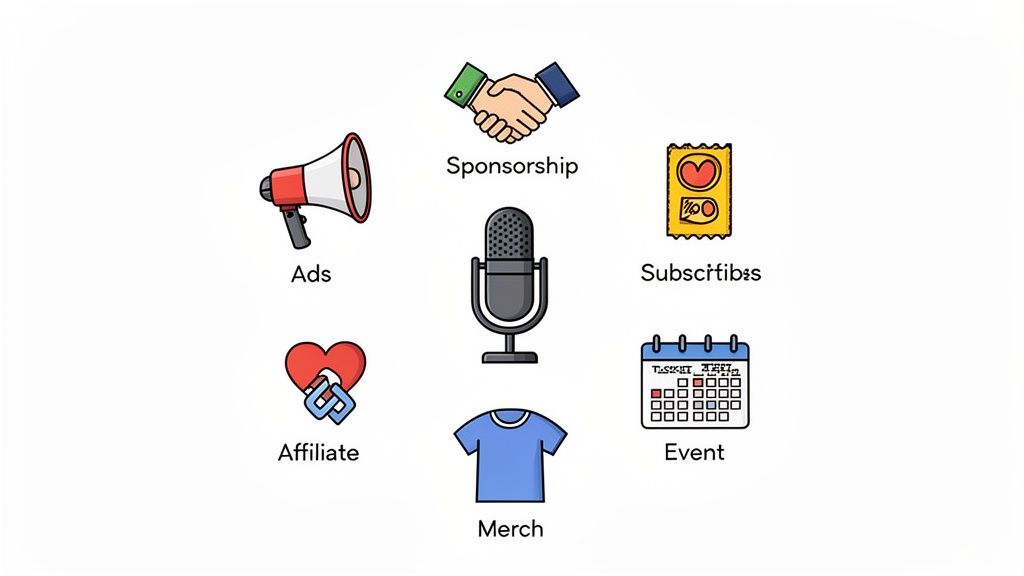
There is no single path to monetizing a podcast. Smart creators combine several income streams. This builds a solid financial foundation for their show. Think of it as a diverse investment portfolio, not a single salary.
This approach is smart business. Relying on one income stream is risky. Mixing and matching these models creates a more stable and scalable business. Let's review the playbook.
1. Advertising and Sponsorships
This is the most common monetization method. A brand pays you to talk about its product. Ads can be placed at the beginning (pre-roll), middle (mid-roll), or end (post-roll). Sponsorships often involve host-read ads, which lend credibility.
Advertising is the top source of podcast revenue. In the U.S., ad revenue is projected to exceed $2 billion in 2024 and reach $2.6 billion by 2026. This category accounts for about 60% of all money in podcasting.
Key Ad Formats:
- Host-Read Ads: The gold standard. You read the ad script in your own voice. This builds listener trust and delivers better results for advertisers.
- Programmatic Ads: These are automated ads. An ad network inserts them into your show. You have less control, but it's a hands-off way to generate passive income.
2. Affiliate Marketing
Affiliate marketing lets you earn money by recommending products you trust. You share a special link or promo code. When a listener makes a purchase, you get a commission. This can work from day one, even with a small audience.
Authenticity is critical. Only recommend products you genuinely believe in. When you do, it feels like a trusted recommendation, not a sales pitch. See how this fits into a broader strategy in our guide on how podcasters get paid.
3. Premium Content and Subscriptions
This model gives dedicated listeners more content for a recurring fee. Platforms like Patreon, Supercast, or Apple Podcasts Subscriptions make it easy to create a members-only experience.
Bottom Line: Direct audience support is a game-changer. It builds predictable, stable income from people who value your work most. It also strengthens your community.
Popular perks include:
- Ad-free episodes for an uninterrupted experience.
- Bonus episodes, such as behind-the-scenes content.
- Early access to regular episodes.
- Exclusive community access via a private Discord or forum.
4. Direct Listener Support
Think of this as a virtual tip jar. It's separate from a formal subscription. Listeners can make one-time donations without receiving exclusive content. It's a simple way for fans to say "thank you." Platforms like Ko-fi or Buy Me a Coffee simplify this process.
5. Selling Your Own Products or Services
Your podcast can be the most powerful marketing engine for your business. You can promote products or services related to your content. This turns listeners into customers. This path is often the most lucrative, as you keep 100% of the profit.
Potential products to sell:
- Digital products: Ebooks, templates, workshops, or online courses.
- Services: Consulting or coaching for individuals or businesses.
- Merchandise: T-shirts, mugs, or other branded items.
6. Live Events and Workshops
Take your podcast beyond the microphone. Live events, whether virtual or in-person, connect you with your audience on a deeper level. This opens a new revenue stream. You can host a live recording, run a workshop, or organize a community meetup.
7. Repurposing Content for Other Platforms
Your audio files are content goldmines. You can turn episodes into videos for YouTube and monetize them with ads. This simple move expands your reach and taps into new income channels without creating new content from scratch.
This is where a tool like PodBrief becomes essential. It instantly generates a clean, AI-powered briefing of your episode. You can use that summary as a foundation for blog posts, newsletters, and social media content. It helps you get your message to more people, on more platforms, faster—accelerating monetization. See how it works and get your first five summaries free at podbrief.io.
How Audience Size Shapes Earning Potential
Your audience size is a major factor in how much money your podcast can make. But it's not just a numbers game. The real magic is at the intersection of reach and engagement. A small, niche podcast with a die-hard following can out-earn a larger show with a passive audience.
You need to understand CPM. This means "Cost Per Mille," or how much an advertiser pays for every 1,000 downloads. It's the industry standard for measuring ad revenue and provides a baseline for potential earnings.
What You Can Realistically Earn
Let's break down potential income at different growth stages. These are estimates. Your niche, audience demographics, and monetization mix can change these numbers significantly.
As a benchmark, a podcast with 10,000 downloads per episode can start earning $500 to $900 per month from sponsorships. That's the point where brands often start to take notice.
1. The Emerging Podcast (1,000 Monthly Downloads)
Your audience is small but likely very loyal. Big-brand sponsorships are off the table for now. This is the perfect time to build your monetization foundation.
- Your Game Plan: Focus on affiliate marketing and direct listener support.
- Affiliate Marketing: Recommending products you trust can bring in $50 - $200 per month. This income is built on audience trust.
- Listener Support: Using a platform like Patreon, convincing just 5% of your listeners to contribute $5 a month adds $250 per month.
2. The Growing Podcast (10,000 Monthly Downloads)
You now have real momentum and a consistent listenership. Sponsorships become a viable option, and you can start stacking income streams.
- Your Game Plan: Pursue sponsorships while continuing affiliate marketing. Consider creating your own product.
- Advertising (at $25 CPM): A single mid-roll ad spot could earn you $250 per episode. With a weekly show, that’s $1,000 a month from just one ad.
- Your Own Products: This audience is large enough to support a small digital product. An ebook or mini-course could add another $500+ per month.
3. The Established Podcast (100,000+ Monthly Downloads)
Welcome to the big leagues. Your podcast is now a media platform. You can command premium ad rates and explore sophisticated monetization strategies. Your authority is your biggest asset.
- Your Game Plan: Secure premium sponsorships, launch high-ticket products, and consider live events.
- Advertising (at $50+ CPM): With premium rates, ad revenue can reach $5,000+ per episode. That's a potential $20,000+ per month.
- Advanced Plays: Use your podcast as a lead magnet for high-ticket coaching, consulting, or speaking gigs, generating tens of thousands on the side.
Why a Niche Audience is Your Secret Weapon
Not all downloads are equal. A podcast about investment strategies for dentists with 5,000 downloads is pure gold to a dental software company. They would pay a premium to reach those specific listeners.
The Bottom Line: A hyper-focused, niche audience has concentrated buying power. Advertisers will pay top dollar to reach them, often at double or triple the average CPM.
Focusing on audience quality over quantity is the smarter long-term play. Building a real connection with the right people creates a sustainable business. Attracting that audience depends on how you present your episodes. Our guide on crafting effective podcast show notes can help.
Estimated Monthly Podcast Revenue By Audience Size
This table breaks down potential monthly income from key monetization streams. It shows how revenue sources scale with audience growth.
| Monthly Downloads | Advertising (CPM: $25) | Affiliate Marketing (Est.) | Patreon (5% conversion @ $5/mo) |
|---|---|---|---|
| 1,000 | $0 - $100 | $50 - $200 | ~$250 |
| 10,000 | $1,000 - $1,500 | $200 - $1,000 | ~$2,500 |
| 100,000 | $10,000 - $20,000+ | $1,000 - $5,000+ | ~$25,000 |
As you can see, relying on a single income stream leaves money on the table. The most successful podcasters build a diversified monetization strategy that grows with their audience.
The Monetization Timeline: From Launch to Profit
Making money from a podcast is a marathon, not a sprint. The path is predictable but requires patience. You must focus on delivering value first.
A common mistake is monetizing too early. This can kill a show before it starts by alienating your community. A successful timeline is built in deliberate phases. Rushing the process almost always backfires.
Phase 1: The Foundation (Episodes 1–20)
Monetization should not be on your radar at the start. For your first 20 episodes, your only job is to create fantastic content and find your first loyal listeners.
This phase is about laying the groundwork. You need to establish a consistent rhythm and prove you are a reliable source of quality content. Every episode builds trust with your audience.
Focus entirely on these fundamentals:
- Content Quality: Ensure crisp audio, a tight episode structure, and clear delivery.
- Publishing Cadence: Pick a schedule and stick to it. Consistency breeds loyalty.
- Audience Feedback: Actively ask for reviews and listen to your early fans.
- Initial Growth: Spread the word on social media to attract your first few hundred listeners.
Trying to insert affiliate links or ask for donations now feels desperate. It sends the wrong message.
Phase 2: The Growth Engine (Episodes 21–50)
You now have a solid back catalog and a small group of engaged listeners. They trust you. Now, you can begin to explore monetization.
The key is to introduce revenue streams that feel authentic. They should not disrupt the listener experience.
This is the time for soft-monetization tactics:
- Affiliate Marketing: Casually mention products you genuinely use. Add affiliate links to your podcast show notes for easy access.
- Listener Support: Set up a page on a platform like Buy Me a Coffee or Ko-fi. This gives fans a low-pressure way to show support.
The bottom line: During this phase, monetization should feel like a natural extension of your content, not an interruption. Your main goal is still audience growth.
Phase 3: The Profitability Stage (Episodes 50+)
With 50+ episodes, your podcast is a valuable asset. You have a real community and consistent downloads. You have earned the authority to pursue bigger financial opportunities.
Now you can confidently chase major sponsors. Diversify your income without it feeling forced. Your audience size now directly translates into earning potential.
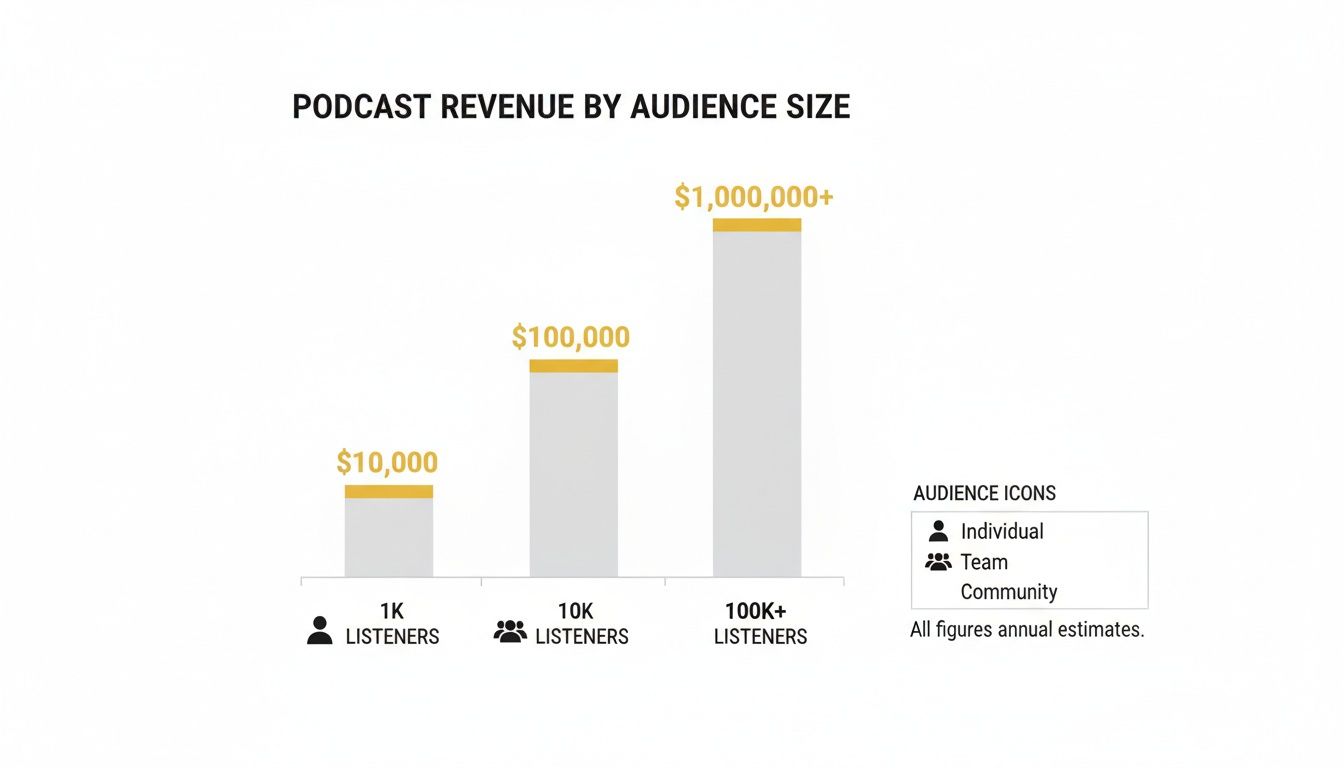
This chart shows how potential income can grow exponentially once you cross certain audience thresholds. It unlocks the next level of monetization.
At this point, you can roll out a full-stack strategy:
- Sponsorships: With 5,000+ downloads per episode, create a media kit and start reaching out to aligned brands.
- Your Own Products: Sell your own online courses, ebooks, or consulting services.
- Premium Content: Launch a subscription model through Patreon or Apple Podcasts. Offer bonus episodes or exclusive community access.
Following this phased approach ensures monetization supports your podcast's growth. It is how you build something that lasts.
Speed Up Your Earnings with Smart Content Repurposing
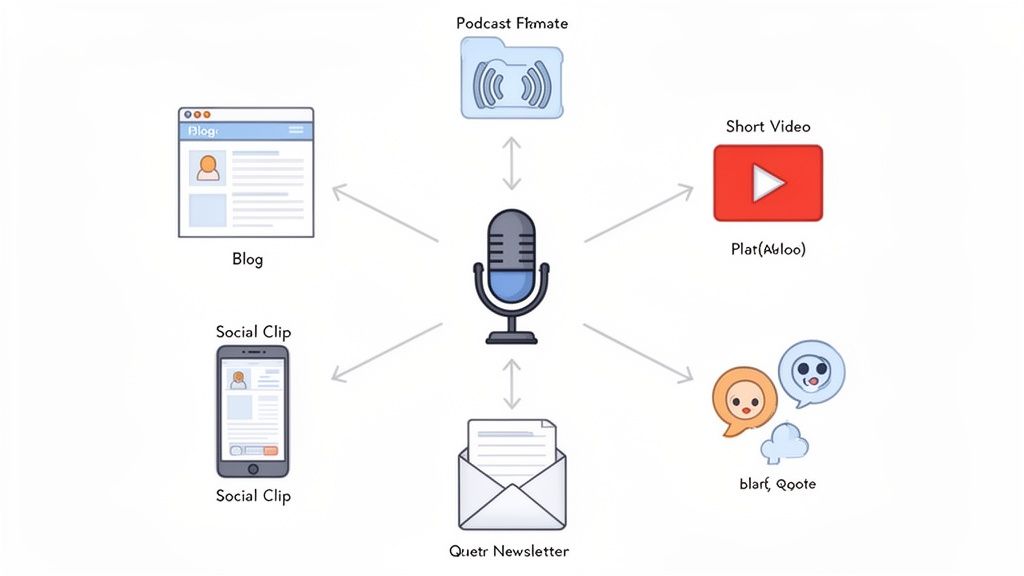
To make real money, you must work smarter, not harder. A podcast episode is a treasure trove of ideas. Leaving it as just an audio file is a wasted opportunity. Smart content repurposing unlocks its full value and accelerates audience and income growth.
The idea is simple. Take one piece of content—your podcast episode—and transform it into multiple assets. This is not about creating more work. It's about getting more mileage from the work you've already done. It’s an efficiency move with a massive impact.
From Audio File to Content Empire
Think of your podcast as the center of your content universe. Each episode can be broken down into new formats. Each format can grab attention on different platforms and draw people into your world.
A single episode can become:
- A Blog Post: Turn the episode into a detailed article to attract search traffic and new listeners.
- Social Media Clips: Extract 30-60 second soundbites for short videos or audiograms on Instagram, TikTok, and LinkedIn.
- A Newsletter: Send a summary of key takeaways to your email list, deepening your connection with core fans.
- Quote Graphics: Create shareable, branded graphics with the most powerful lines from your episode.
The Workflow That Makes You Money
Repurposing is a great idea, but it takes time. The manual labor of transcribing, summarizing, and rewriting is a major roadblock. This is where smart automation becomes your secret weapon.
Bottom Line: The faster you repurpose content, the faster you grow your audience. Faster audience growth means faster monetization.
Tools like PodBrief were built to solve this problem. Our AI generates a clean, detailed summary of your episode in minutes. This summary becomes the raw material for all your other content. Our guide on creating a quality transcript for your podcast shows how this text can fuel your entire content engine.
This isn't just about saving time. It's a direct strategy to boost your podcast's earning potential. Expanding your reach attracts more listeners. More listeners make you more valuable to sponsors and increase potential customers.
Your Action Plan for Monetization
Knowing how podcasts make money is one thing. Getting paid requires a plan. Here is a straightforward roadmap to start today. These are immediate, practical steps to build your monetization foundation.
Step 1: Nail Your Value Proposition
You must be clear on why your podcast is worth someone's time and money. Who are you talking to? What problem do you solve? A vague pitch gets ignored. A sharp, focused value proposition opens wallets.
Your Action: Write a single sentence that answers this: "My podcast helps [a specific type of person] achieve [a specific outcome]." This sentence is the heart of your brand. Clarity is your most valuable asset.
Step 2: Set Up Direct Listener Support
Don't wait for a big sponsor. Make it easy for your most dedicated fans to support you directly. This creates an immediate income stream. It also proves that people find your content valuable.
- Pick a Platform: Sign up for a free account on a service like Buy Me a Coffee or Ko-fi. They simplify one-off tips or small, recurring contributions.
- Craft a Clear Call-to-Action (CTA): At the end of your next episode, add a simple request. "If you got value from this episode, you can support the show at [your link]. It helps us keep the content flowing."
Step 3: Kickstart Your Affiliate Strategy
Affiliate marketing is the quickest way to earn revenue without creating a product. You earn a commission for recommending products you trust. Authenticity is key.
Your Action:
- List Your Go-To Tools: List 3-5 tools, books, or services you use that would benefit your listeners.
- Find Their Programs: Search for "[Product Name] affiliate program." Many large companies have easy-to-join programs.
- Weave It In Naturally: Mention these products when it makes sense and add your affiliate links in the show notes.
Bottom Line: Monetization is a system you build piece by piece. These foundational steps create the infrastructure that will support you long-term.
Look at how the PodBrief homepage communicates its value instantly.
The tool solves a clear problem: too much content, not enough time. AI-generated summaries offer a powerful hook because they address a specific pain point.
Step 4: Create a Simple Media Kit
A media kit is a one-page document for potential sponsors. It tells them everything they need to know about your show. Having one ready makes you look professional.
Your kit should have:
- Your one-sentence value proposition.
- A description of your listeners.
- Your current download numbers (be honest).
- Your contact info.
This preparation ensures you're ready when an opportunity arises. Smart workflows speed up monetization. Tools like PodBrief help by providing instant AI briefings of your episodes. This allows you to quickly repurpose content for blogs and newsletters, growing your audience faster.
Your Top Podcast Monetization Questions, Answered
Let's cut to the chase. You have questions about how the money works in podcasting. Here are straight answers to the most common ones.
How Many Listeners Do You Need to Make Money?
There is no magic number. Profitability is about audience engagement, not raw downloads. You can start earning with a small, passionate audience from day one.
- Under 1,000 Downloads: Focus on affiliate marketing and direct listener support. A loyal community of 500 is more valuable than 5,000 passive listeners.
- 5,000 - 10,000 Downloads: You are now on the radar for brand sponsorships. A single ad spot per episode can become a steady income source.
- 50,000+ Downloads: You are a media platform. You can command top-tier ad rates and launch high-ticket products.
The Real Takeaway: Stop chasing vanity metrics. Build a real community. A small, dedicated audience is infinitely more profitable than a massive, passive one.
Which Podcast Genres Make the Most Money?
Any niche can be profitable. However, some genres are easier to monetize. They attract advertisers with deep pockets and listeners with a buying mindset.
The most profitable categories include:
- Business and Finance: Listeners are actively seeking solutions to expensive problems.
- Technology: A goldmine for B2B sponsors trying to reach a savvy, specific audience.
- Health and Wellness: A massive market where listeners are constantly investing in themselves.
- True Crime: Enormous and fiercely loyal audiences, perfect for direct-to-consumer brands.
Can You Get Paid Directly From Spotify or Apple Podcasts?
Yes and no. Platforms like Spotify and Apple Podcasts do not pay you for your downloads. They are facilitators, not employers. They provide tools to build your own revenue streams.
- Apple Podcasts Subscriptions: This lets you sell premium content directly in the Apple Podcasts app. You can offer ad-free episodes or exclusive content. Apple takes a cut.
- Spotify's Ad Programs: Spotify's Audience Network automatically inserts programmatic ads. It's a hands-off way to earn, but you lose control over the ads.
The bottom line is simple: do not rely solely on platform tools. The most successful podcasters build a diversified business they own and control completely. This includes affiliate marketing and their own digital products.
Keeping up with monetization strategies is a full-time job. You need to know what works for top shows without spending hours listening to each one. That's where PodBrief comes in. Our AI-powered summaries distill any podcast episode into key insights, giving you actionable intelligence in minutes.
Ready to fast-track your learning and build a more profitable show? Try PodBrief for free and get your first five summaries on us.


