
How to Process Information Faster: An Executive's Guide

To process information faster, you must stop being a passive consumer. Get active and strategic. This is about filtering signal from noise to make smarter decisions and reclaim your time. Forget generic advice. The key is using proven techniques and the right tools to turn the information firehose into a competitive advantage.
The Executive Challenge: Information Overload
Your ability to quickly absorb and act on new information defines your effectiveness. You are likely drowning in data—market reports, industry podcasts, and internal updates. This constant influx creates a massive cognitive load, slowing down your decision-making and killing productivity. The problem isn't just volume; it's velocity.
Cognitive processing speed is a foundational leadership skill. It determines how fast you grasp complex topics, spot emerging trends, and pivot your strategy. This guide is your framework for mastering that skill through proven techniques, daily routines, and effective tools.

The Real Reason Faster Thinking Gives You an Edge
In high-stakes business, how fast you think keeps you in the game. Your brain's processing speed drives everything from memory to executive function. It allows you to cut through the noise and make critical decisions when it matters most.
This isn't about working harder. It's about making your brain work smarter. Imagine pulling critical insights from a 60-minute podcast in just minutes. That’s not just efficiency; it’s a strategic advantage that sets top performers apart.

What Science Says About Speed and Success
The link between quick thinking and high performance is backed by research. Studies show the brain's ability to quickly analyze and act on new information is a key indicator of long-term cognitive success. A landmark 2023 study revealed that people with faster processing speeds were 3.81 times more likely to achieve 'SuperAging' status, outperforming peers in memory and executive function decades later.
For leaders, this translates directly into spotting patterns faster and making agile decisions. It is the capacity to stay ahead when information comes from all directions.
The Bottom Line: Faster cognitive processing gives you the ability to spot opportunities and sidestep threats long before your competition. That's a decisive edge.
Turning Overload into Actionable Insight
Think about your typical day. A 60-minute podcast likely has one or two key insights buried in small talk. A 40-page report might hide its most critical data in a single chart. The real challenge is pulling out what matters—fast.
This is where you can turn a bottleneck into a strength. When you process information faster, you can:
- Instantly pinpoint key takeaways from any long-form content.
- Connect unrelated ideas to form a clearer, bigger picture.
- Respond to market changes with more confidence and speed.
- Cut down cognitive load, freeing up mental energy for strategic thinking.
The goal is to change your relationship with information. Stop being reactive. Start being proactive. Tools like an AI podcast summarizer automate this extraction, turning hours of audio into a concise brief you can act on immediately.
Actionable Techniques to Train Your Brain For Speed
Boosting your processing speed is a skill you can build. Think of it like training a muscle. Your brain can be wired for higher velocity with deliberate practice using the right methods. This is your toolkit of cognitive techniques to start using today.
These are not abstract theories. They are practical, battle-tested approaches for absorbing, understanding, and retaining information more effectively. Each one targets a specific bottleneck in how we think.
Master the Art of Chunking
Your working memory is limited. Chunking is a powerful practice of grouping related items into a single, meaningful unit. This trick dramatically cuts cognitive load, making complex topics easier to digest. A phone number is the classic example: you remember three chunks, not ten random digits.
Apply this directly to your work:
- Board Reports: Group data points into key trends like Revenue Growth, Operational Efficiency, and Market Expansion.
- Competitor Analysis: Break down a competitor's strategy into chunks like Product Line, Marketing Channels, and Customer Demographics.
Organizing information into logical clusters creates mental "handles" that make retrieval faster and more reliable.
Implement Strategic Skimming
Reading every word is a waste of time. Strategic skimming is about surgically extracting the core message without getting bogged down in fluff. The goal is to read smarter by zeroing in on high-value areas.
Before diving into a dense document, take 60 seconds to scan these elements first:
- Headings and Subheadings: They provide the argument's outline.
- First and Last Sentences of Paragraphs: They almost always contain the main idea.
- Bolded Text and Bullet Points: The author has highlighted what’s important.
- Charts and Graphs: Visual data tells a story faster than text.
This pre-read creates a mental map of the content. You will know which sections are worth a deeper dive, saving you time.
Use Active Recall to Solidify Knowledge
Passive consumption leads to poor retention. Active recall forces your brain to retrieve information without looking at the source. This effort strengthens neural pathways and cements learning. It is the difference between recognizing a concept and truly understanding it.
The Feynman Technique is a great way to practice this. After learning something new, explain it aloud in the simplest terms possible, as if teaching a colleague.
If you can't explain a concept simply, you don't understand it well enough. This process immediately reveals your knowledge gaps, showing you exactly where you need to reinforce your understanding.
This is a game-changer for preparation. Before a pitch, summarize the client's challenges and your solutions from memory. This forces you to internalize critical information, not just parrot it back.
This table is your quick-reference guide for choosing the right mental tool for the job.
Cognitive Techniques For Faster Processing
| Technique | Core Principle | Best For |
|---|---|---|
| Chunking | Grouping related information to reduce cognitive load. | Grasping complex reports, learning new systems, or memorizing structured data. |
| Strategic Skimming | Prioritizing high-signal sections (headings, intros) to get the gist quickly. | Quickly evaluating articles, reports, or emails to decide if a deep read is necessary. |
| Active Recall | Forcing your brain to retrieve information from memory. | Preparing for presentations, ensuring you've internalized key meeting points, and long-term learning. |
| Mind Mapping | Visually organizing information in a non-linear, hierarchical way. | Brainstorming sessions, summarizing a book or long article, and planning complex projects. |
| The Feynman Technique | Explaining a concept in simple terms to identify knowledge gaps. | Deeply understanding a new or difficult topic before you have to explain it to others. |
The real power comes from combining these techniques into a fluid workflow that fits your specific needs.
Building Your High-Speed Information Workflow
Knowing the theory is one thing; putting it into practice is what matters. Cognitive techniques are useless without a repeatable system. Here is a blueprint for a daily workflow that turns faster information processing into a habit.
This process is built on a few core ideas: breaking things down, getting the gist quickly, and then locking it in.
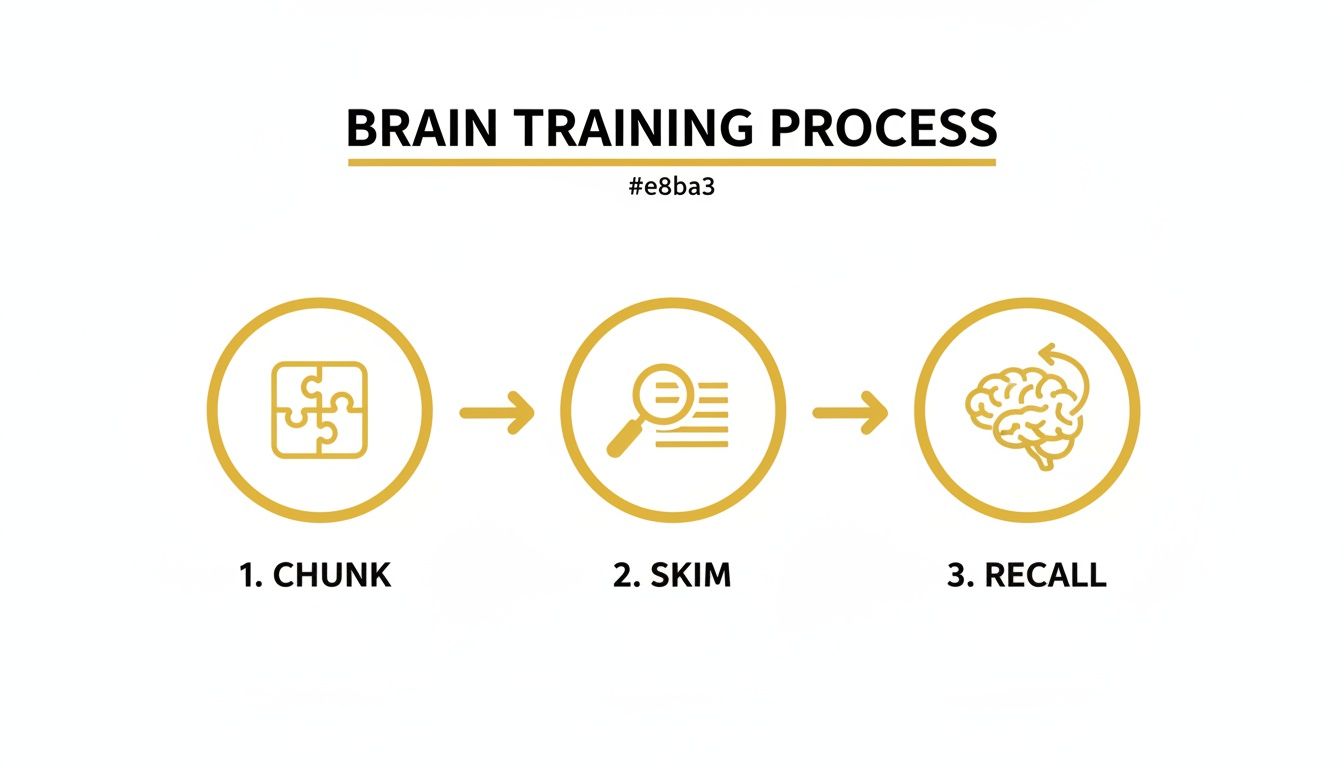
The insight is that speed isn't just about reading faster. It’s a deliberate cycle of chunking, skimming, and actively recalling what you consumed.
Prime Your Brain in the First 30 Minutes
How you start your morning can make or break your cognitive performance. Before opening your inbox, dedicate 30 minutes to consuming high-signal information. This warms up your brain for critical thinking before the daily chaos begins.
The goal is to absorb essential industry updates or market analysis. This isn't the time for random articles. Curate your sources ruthlessly and stick to content that gives you a strategic edge.
Structure Your Day With Time Boxing
To stay focused, you need structure. The Pomodoro Technique is a fantastic framework for this. You work in focused 25-minute sprints, followed by a 5-minute break. This simple rhythm prevents mental burnout.
Schedule these "information blocks" in your calendar like any other meeting. When you're in a block, eliminate distractions. Close your email, silence your phone, and give your full attention to one task.
Batch Process Similar Information
Jumping between different information types—like an email, a podcast, and a report—creates cognitive friction. The fix is batch processing. Grouping similar tasks builds mental momentum.
Think about it this way:
- Email Block: Carve out one or two daily sessions to clear your inbox.
- Podcast Brief Block: Review all your podcast summaries at once.
- Report Block: Analyze all relevant reports in one focused session.
This approach cuts down on context switching. It's more efficient. For audio content, this is a game-changer; a tool that can translate audio to text lets you batch-read summaries instead of listening on and off all day.
The Bottom Line: A structured workflow is non-negotiable for high performance. Dedicating specific times to specific information types makes efficient processing second nature.
Curate Your Information Diet
You cannot consume everything. A huge part of processing information faster is learning what to ignore. Create an "Information Diet" by ruthlessly prioritizing high-quality sources and cutting out low-value noise.
For every piece of content, ask: does this help my goals or improve my strategic awareness? If the answer is no, get rid of it. This discipline ensures your limited cognitive bandwidth is spent only on what truly matters.
Using Technology to Learn Smarter, Not Harder
Training your brain is essential, but technology must do the heavy lifting. The right tools act as a force multiplier, filtering and summarizing so you can jump straight to analysis and action.
This is not about another note-taking app. This is about a tech stack designed to extract core knowledge from any content. These tools feed you information in a way that aligns with how your brain works, boosting retention and recall.
Building Your Cognitive Toolkit
Most "productivity" tools create more clutter. An effective tool gives you less to manage, not more. Zero in on services that automate the most tedious, time-consuming steps.
Look for solutions that excel at:
- Automated Summarization: Tools that boil down long articles, reports, or podcasts into scannable briefs.
- Intelligent Curation: Services that learn what you care about and filter out the noise.
- Cross-Platform Sync: Platforms that keep your notes and summaries available on any device.
The point is to have information pre-digested before it hits your screen. This frees up mental bandwidth for high-level thinking.
How AI Changes Knowledge Work
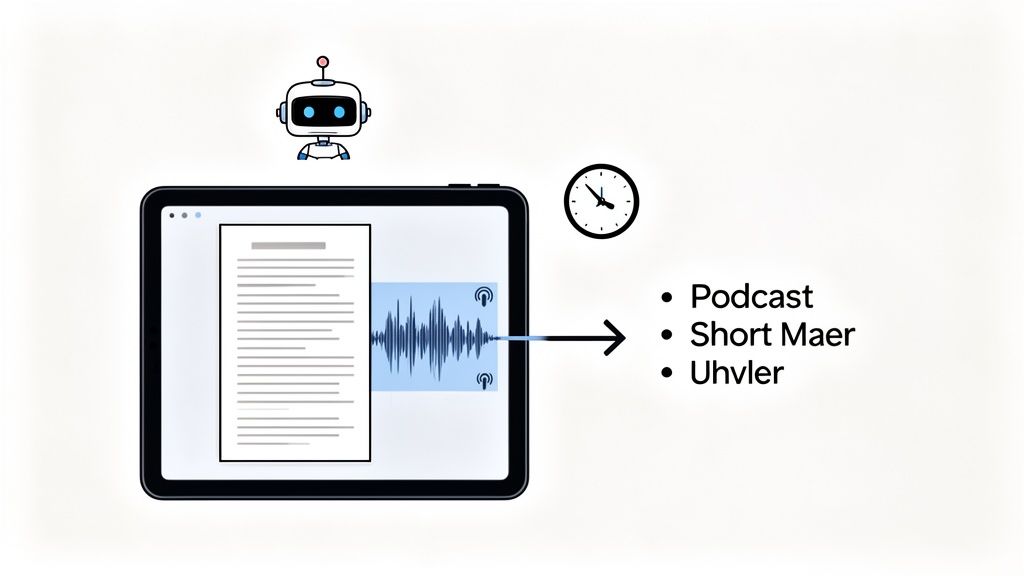
AI-powered services are a game-changer for busy professionals. They transform unstructured content like podcasts into actionable insights. Instead of spending an hour on a podcast, get the key takeaways in a five-minute read. This is about precision, not just saving time.
Slower processing speeds can lead to 15-20% lower output in knowledge-heavy roles. By turning a one-hour podcast into a five-minute summary, AI tools can deliver 90% time savings while keeping the essential ideas. PodBrief does exactly this. It delivers AI-briefings of podcasts so you can absorb key ideas in minutes.
The Bottom Line: AI-driven summarization gives you an incredible advantage. You can cover 5x more ground than competitors still slogging through content manually.
Weaving New Tools Into Your Daily Routine
The final step is making these tools a natural part of your day. Your morning could start with a review of AI-generated briefs from key industry podcasts. If you're curious about other tools, our guide to the best AI for podcasters is a great place to start.
By automating the front end of your information workflow, you create a powerful system. This tech-enabled approach ensures you're always informed without feeling overwhelmed, giving you a lasting competitive edge.
Tying It All Together: From Overload to Insight
Mastering information processing is a journey. It blends cognitive science, smart daily habits, and the right tools. You're building a personal system that turns the data firehose from a source of stress into a strategic advantage.
The principles are simple. It starts with understanding how your brain learns. Then, layer in techniques like chunking and active recall to ensure you remember what you consume.
But if there's one takeaway, it's this: speed without comprehension is useless. The goal isn't just to get through content faster; it's to get smarter, make better decisions, and act with more confidence.
Your First Move
Don't try to change everything overnight. Start small. Pick one thing to focus on this week. Maybe you strategically skim every report before diving in. This small win will build momentum.
True mastery isn't about consuming everything. It's about extracting maximum value from the few things that genuinely matter.
Ready to take control? The fastest way to see a difference is to stop drinking from the firehose. See how a purpose-built tool like PodBrief can change your workflow by delivering core insights without the fluff. Stop letting information overload run your day.
Got Questions? We’ve Got Answers
Here are answers to common questions about making these speed-processing habits stick.
How Long Until I Actually Get Faster at This?
You'll feel a difference sooner than you think. With consistent effort, most people notice quicker comprehension in two to four weeks. Timed cognitive drills can yield a 15% speed improvement in the first month. Real change comes from building a workflow you stick with.
Key Takeaway: Consistency is more important than intensity. Weave one or two new habits, like strategic skimming, into your daily routine.
Is It Ever Okay to Multitask?
Almost never. Multitasking is a productivity killer. Juggling multiple information streams can tank your efficiency by up to 40%. Every time you switch tasks, your brain pays a "cognitive cost" that slows you down.
For anything that matters, single-tasking is king. Dedicate your full attention to one thing at a time. You'll finish faster and understand it better. The only exception is passive listening during a mindless physical task, like a commute.
What’s the Best Tactic for a Super-Busy Executive?
For a packed calendar, use a two-part strategy: ruthless prioritization and smart technology. First, get strict about what you consume. If it's not critical to your immediate goals, cut it out.
Second, use a tool that does the grunt work. Instead of spending hours on podcasts, use a service like PodBrief to get AI-powered summaries of all of them in under 15 minutes. This frees you to focus on analysis, strategy, and making the right decisions.
Ready to stop drowning in information and start dominating it? PodBrief gives you executive summaries of long podcasts so you can absorb key insights in minutes, not hours.
Try PodBrief for free and get your first AI-briefings instantly.


