
10 Knowledge Management Best Practices to Implement Today

Information is everywhere. Actionable knowledge is not. For busy professionals, the challenge is extracting value from information efficiently. Time spent sifting through reports, podcasts, or documents is lost productivity. A scattered approach to information is a competitive disadvantage.
This guide delivers actionable knowledge management best practices. These are high-utility strategies to transform how your team consumes, organizes, and applies information. The goal is a robust system for faster, more informed decision-making.
1. Capture and Summarization Strategy
Effective knowledge management starts with a system to capture and condense information. This process extracts core ideas from long-form content like podcasts, meetings, or reports. It preserves essential knowledge while eliminating noise.
This practice is essential in today's fast-paced environment. It makes critical information easier to consume, retain, and act upon. It prevents information overload.

Why It Matters
Implementing this is one of the most impactful knowledge management best practices. It directly addresses information saturation. It makes knowledge accessible and immediately useful.
For example, PodBrief transforms hour-long podcasts into five-minute briefs. This allows executives to absorb key insights in a fraction of the time. This is your first line of defense against wasted time.
How to Implement It
- Define Your Focus: Before summarizing, know your goal. Are you extracting tasks, KPIs, or strategic concepts? Tailor the summary to the audience.
- Establish a Consistent Format: Create a standard template for all summaries. Include sections for key takeaways, direct quotes, and action items. Consistency makes information easy to find.
- Leverage AI-Powered Tools: Manual summarization doesn't scale. Using an AI summarizer for your team’s knowledge base automates the process for speed and accuracy.
- Validate and Refine: Test your summaries with a small user group. Get feedback to ensure they are valuable before scaling the process.
2. Personal Knowledge Library Systems
Knowledge management isn't just for organizations; it's for individuals. A personal knowledge library is a central, searchable place for your own insights, notes, and references. The goal is to create a "second brain" so valuable information is never lost.
This system is crucial for professionals who need to recall specific details later. It turns passive consumption into a lasting, searchable asset.
Why It Matters
This is a core knowledge management best practice. It empowers individuals to compound their learning over time. Every piece of content becomes a reusable asset.
For instance, PodBrief's library lets you save and search every brief you generate. This creates a personal database of insights from expert audio content. It makes every listened-to podcast a permanent, searchable resource.
How to Implement It
- Establish Consistent Tagging: Start with a simple tagging system. Use tags for projects (#Q4-report), topics (#AI-ethics), and content types (#podcast-summary).
- Choose a System That Matches Your Workflow: Select a tool that fits how you work. Options include Notion, Obsidian, and Evernote.
- Schedule Regular Reviews: Set aside time each week to organize new entries. This practice reinforces learning and helps connect ideas.
- Focus on Linking Ideas: The power of a personal library is its network. Actively link related notes and briefs to build a web of interconnected knowledge.
3. Multi-Format Knowledge Delivery
People consume information differently. Multi-format knowledge delivery presents the same core information in various formats, such as text, audio, and visual summaries. This makes knowledge accessible whether an employee is reading, listening, or reviewing a dashboard.
This practice moves beyond a one-size-fits-all approach. It dramatically increases knowledge adoption and retention. The goal is to make knowledge frictionless.
Why It Matters
This is one of the most user-centric knowledge management best practices. It meets team members where they are. Offering choice removes barriers to engagement.
For instance, providing both a text summary and an audio version of a meeting allows a manager to review it at their desk or listen during their commute. This flexibility increases the chance the information will be consumed.
How to Implement It
- Prioritize Core Formats: Start with text and audio. A concise text summary is scannable and searchable. An audio version is ideal for multitasking.
- Ensure Content Parity: The essential takeaways must be consistent across all formats. The delivery method changes, but the core knowledge does not.
- Leverage Technology for Conversion: Manually creating multiple versions is inefficient. Use technology to streamline the process. You can learn how to translate audio to text to quickly generate transcripts from recordings.
- Gather User Feedback: Collect data on which formats are most popular. Use these insights to refine your strategy.
4. Contextual Tagging and Semantic Organization
A sophisticated knowledge system connects assets by their meaning, not just file names. Contextual tagging and semantic organization use intelligent metadata to create a web of interconnected information. The goal is a knowledge base that "understands" how different pieces of information relate.
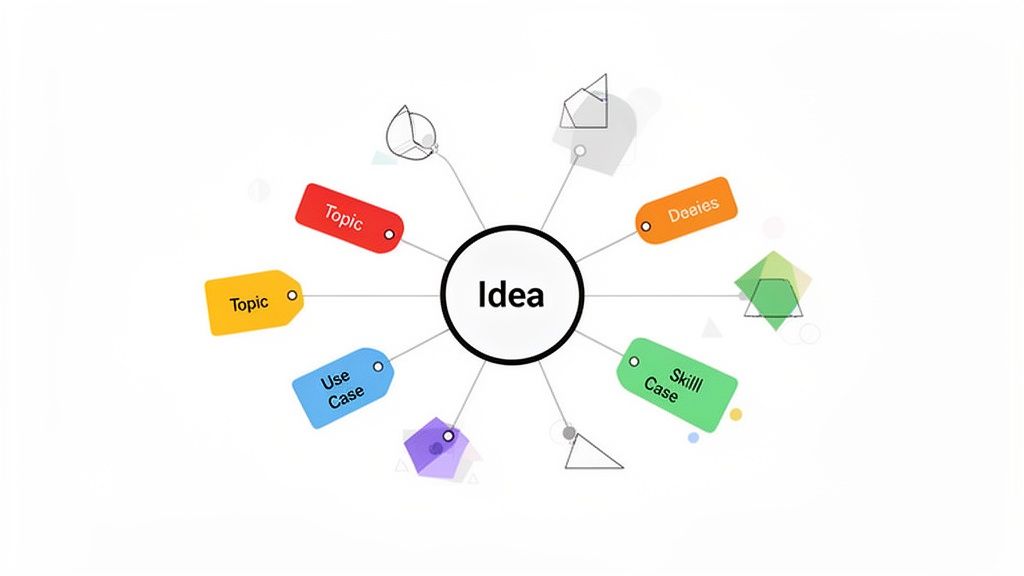
This practice mirrors how the human brain makes connections. It enables users to discover relevant insights they weren't even looking for.
Why It Matters
This is one of the most transformative knowledge management best practices. It moves your system from a static repository to a dynamic, intelligent network.
For example, a user looking at a summary about "supply chain logistics" could be shown related briefs on "inventory management AI" and "last-mile delivery trends," surfacing valuable connections they might have missed.
How to Implement It
- Start with a Minimal Vocabulary: Begin with a small, controlled set of core tags. Expand based on user search behavior, not assumptions.
- Combine Automation and Human Input: Use AI tools to suggest initial tags. Allow users to refine them for greater accuracy.
- Establish Naming Conventions: Create clear rules for tags to avoid duplicates (e.g., "report" vs. "reports").
- Periodically Audit and Refine: Schedule regular reviews to merge redundant tags. This "tag gardening" keeps the system clean and effective.
5. Spaced Repetition and Retrieval Practice
Capturing knowledge is not enough. It must be retained. Spaced repetition is a learning technique that re-exposes you to information at increasing intervals to optimize long-term memory. This transforms passive consumption into durable knowledge.
This method ensures critical insights from summaries and reports become part of your team's core, accessible memory. It combats the natural "forgetting curve."

Why It Matters
This is one of the most powerful knowledge management best practices because it directly fights knowledge decay. It turns your knowledge base into an active learning tool.
For instance, revisiting a key podcast brief on a market trend just before a strategy meeting ensures the insights are top of mind, not forgotten.
How to Implement It
- Integrate Active Recall: Don't just re-read. Frame key takeaways as questions that require users to retrieve information from memory.
- Keep Review Sessions Brief: Schedule short, focused review sessions (5-10 minutes). The goal is frequent, low-effort reinforcement.
- Leverage Automated Tools: Manually tracking intervals is impractical. Use tools that automate the scheduling process.
- Provide Progress Metrics: Motivate users by showing their "retention score" over time. Learn more about how to process information faster with proven techniques.
6. Just-in-Time Information Architecture
A just-in-time architecture delivers information at the exact moment it is needed. Instead of overwhelming users with data, this aligns content delivery with their workflow. The goal is to maximize applicability and reduce cognitive load.
This proactive delivery transforms a passive knowledge base into an active, intelligent partner. It empowers faster, more accurate decisions.
Why It Matters
This is one of the most advanced knowledge management best practices. It shifts the burden of finding information from the user to the system.
Imagine your calendar automatically surfacing a brief on a competitor just before your meeting with them. That is just-in-time knowledge delivery. It provides the right information without the user having to search for it.
How to Implement It
- Map User Workflows: Identify key decision points and information needs in common tasks. Where do people get stuck?
- Start with Simple Triggers: Begin with simple automations. For example, link a sales battle card to a CRM stage.
- Combine Contextual Signals: For greater accuracy, integrate multiple data points like user role, search history, and calendar events.
- Prioritize Transparency and Control: Explain why information is being surfaced. Allow users to provide feedback to build trust and improve the system.
7. Source Attribution and Credibility Verification
Knowledge is only as valuable as its source. Source attribution maintains clear connections between insights and their original content. This process ensures users can evaluate the quality of information and trust the knowledge base.
This practice is critical for building a high-integrity system. It allows users to gauge confidence and conduct further investigation when necessary.
Why It Matters
This is one of the most essential knowledge management best practices. It builds long-term trust and intellectual rigor.
Knowing if an insight came from a vetted industry report or an unverified comment is crucial. Credibility is the foundation of an actionable knowledge base.
How to Implement It
- Standardize Source Metadata: For every piece of knowledge, capture the author, publication, and date to assess timeliness.
- Link Directly to the Origin: Whenever possible, link from the summary back to the original content. This allows for easy verification.
- Establish Verification Workflows: Create a simple process for team members to flag or question information.
- Develop Credibility Indicators: Use internal scores or tags to indicate the reliability of frequently cited sources or experts.
8. Cross-Lingual Knowledge Transfer
Valuable insights don't respect language boundaries. Cross-lingual knowledge transfer is the practice of translating and localizing knowledge for a global audience. This ensures information is accessible to everyone, regardless of their native language.
This practice is critical for global organizations aiming to create a unified knowledge base. It maximizes accessibility and fosters inclusivity.
Why It Matters
This is one of the most forward-thinking knowledge management best practices. It unlocks the full potential of your intellectual capital across a global workforce.
If a key market insight is published in German, a translated summary makes it immediately available to your English-speaking sales team, preventing a critical knowledge gap.
How to Implement It
- Prioritize Languages Strategically: Analyze your user demographics to prioritize which languages will deliver the highest impact first.
- Build a Centralized Glossary: Create a master glossary for domain-specific terminology to ensure consistent translation.
- Combine AI with Human Expertise: Use AI translation for speed. Always have a native speaker review the output to catch cultural nuances.
- Partner for Cultural Adaptation: Go beyond direct translation. Work with experts to adapt examples and idioms for the target audience.
9. Active Engagement and Recall Testing
Effective knowledge management ensures information is truly learned. Active engagement transforms passive consumption into an active learning process. This involves prompting users with questions or exercises about the content they just consumed.
This method, known as retrieval practice, dramatically improves long-term retention. It turns a quick briefing into durable knowledge.
Why It Matters
This is one of the most powerful knowledge management best practices. It closes the loop between information access and genuine comprehension.
For instance, asking a user to identify the single most important takeaway from a brief forces their brain to process the information more deeply than passive reading would.
How to Implement It
- Integrate Brief Quizzes: Following a summary, present 2-3 questions that cover the core takeaways. Keep them brief.
- Use Varied Formats: Mix up engagement types. Use scenario-based questions like, "How would you apply this finding?"
- Provide Immediate Feedback: Show the correct answer and a brief explanation immediately. This reinforces correct information instantly.
- Build Community Features: Create a space where team members can discuss the content's real-world applications and ask questions.
10. Collaborative Filtering and Insight Sharing
Effective knowledge management fosters a dynamic ecosystem. Collaborative filtering allows users to contribute their own perspectives and applications to existing knowledge assets. This transforms a one-way repository into a community-driven commons.
This approach turns passive consumption into active participation. Team members build upon information, validate it, and contextualize it.
Why It Matters
This is one of the most powerful knowledge management best practices. It unlocks the tacit knowledge held by individuals and makes it available to everyone.
A sales team might annotate a summarized podcast on market trends with their own on-the-ground observations. This enriches the original brief with priceless real-world context.
How to Implement It
- Make Annotation Seamless: Integrate one-click functionality for users to add comments and highlights directly onto assets.
- Establish Quality and Moderation: Implement a system for community moderation or expert review to filter contributions.
- Incentivize Quality Contributions: Create a reputation system that rewards users for valuable contributions, like badges or leaderboards.
- Surface the Best Insights: Use voting mechanisms to highlight the most helpful community annotations alongside the original content.
10-Point Comparison of Knowledge Management Best Practices
| Approach | Implementation Complexity 🔄 | Resource Requirements ⚡ | Expected Outcomes 📊⭐ | Ideal Use Cases 💡 | Key Advantages ⭐ |
|---|---|---|---|---|---|
| Capture and Summarization Strategy | Moderate — NLP pipelines and iterative tuning | Medium — models, compute, training data | High concise insight delivery; faster decision-making; ⭐⭐⭐⭐ | Long-form podcast/video condensation; executive briefs | Reduces time-to-insight; scalable; preserves core context |
| Personal Knowledge Library Systems | Low–Moderate — storage, search, sync, UX | Low–Medium — DBs, indexing, synchronization | High long-term utility; searchable institutional memory; ⭐⭐⭐ | Research, meeting prep, knowledge retrieval | Transforms passive consumption into retrievable assets |
| Multi-Format Knowledge Delivery | High — parallel production and format optimization | High — production, audio talent, format QA | High accessibility and engagement across contexts; ⭐⭐⭐⭐ | Diverse audiences; accessibility needs; mobile use | Maximizes reach; supports multiple learning styles |
| Contextual Tagging & Semantic Organization | High — ontology design and semantic models | High — ML models, taxonomy curation, labeling | High discoverability and cross-domain insights; ⭐⭐⭐⭐ | Large content libraries; research; knowledge discovery | Connects related content; improves search relevance |
| Spaced Repetition & Retrieval Practice | Moderate — scheduling algorithms and UX flows | Medium — tracking, notifications, content conversion | Very high long-term retention and recall; ⭐⭐⭐⭐⭐ | Skill learning, exam prep, long-term mastery | Optimizes memory retention; increases ROI on content |
| Just-in-Time Information Architecture | Very high — context signals, integrations, ranking | High — analytics, integrations, privacy controls | High relevance and faster decisions; reduced overload; ⭐⭐⭐⭐ | Workflow-triggered briefs, meeting prep, sales enablement | Delivers timely actionable insights in-context |
| Source Attribution & Credibility Verification | Moderate — metadata capture and verification workflows | Medium — expert review, linking, provenance tooling | High trust and transparency; easier verification; ⭐⭐⭐⭐ | Professional, academic, compliance-sensitive use | Builds credibility; prevents misinformation |
| Cross-Lingual Knowledge Transfer | High — translation + cultural localization pipelines | High — NMT, human translators, QA, voice localization | High audience expansion; variable nuance retention; ⭐⭐⭐ | Global audiences; multilingual teams; market expansion | Expands reach and inclusion across languages |
| Active Engagement & Recall Testing | Moderate — question generation and assessment analytics | Medium — content authoring, assessment tools, tracking | Very high retention and application; immediate feedback; ⭐⭐⭐⭐⭐ | Training, upskilling, deliberate practice | Converts passive listening into mastery through retrieval |
| Collaborative Filtering & Insight Sharing | Moderate — social features, moderation, recommender systems | Medium — moderation, community tooling, algorithms | High engagement and improved content through crowdsourcing; ⭐⭐⭐ | Community curation, peer learning, collective sensemaking | Network effects; diverse perspectives improve quality |
Turn These Practices into Your Competitive Edge
Mastering knowledge management is a strategic discipline. You now have a blueprint for creating an intelligent information ecosystem. Implementing these knowledge management best practices is the definitive step toward a more agile, informed, and competitive organization.
The core theme is a shift from passive consumption to active engagement. It's about transforming raw data into a strategic asset. By embracing a robust capture and summarization strategy, you stop valuable insights from evaporating.
Your Actionable Next Steps
Do not implement everything at once. Identify your biggest bottleneck and start there.
Is it the volume of unstructured audio? Start with a better capture and summarization strategy. Is it difficulty finding information later? Focus on contextual tagging. Select one or two practices and commit to them for the next 30 days.
This incremental approach ensures sustainable change. The goal is to build a resilient framework that turns institutional knowledge into your most potent competitive advantage.
Ready to build the foundation of your knowledge management system? PodBrief automates the capture and summarization of audio content, turning hour-long podcasts into concise, actionable briefs. Start implementing these best practices today. Try PodBrief for free to get an AI-briefing of the topics that matter to you.


