
Automated Podcast Notes: A Guide to Smarter Listening

Podcasts are a goldmine of information. But who has time to listen to it all? For busy professionals, sitting through hours of audio is not a smart use of time. This is where automated podcast notes come in.
Think of them as your secret weapon. They turn lengthy episodes into concise, actionable summaries. Smart AI does the heavy lifting, so you absorb key takeaways in minutes, not hours.
From Information Overload to Actionable Intelligence
The real magic is shifting from passive listening to strategic value extraction. Automated summaries become your personal intelligence briefing. They distill rambling conversations into a clean, scannable report.
The goal is simple: get more knowledge in less time. This isn't just about saving minutes. It’s about learning how to process information faster and gaining a genuine edge. Stop drowning in audio and start turning insights into intelligence that drives smarter decisions.
How Automated Podcast Notes Actually Work
What happens behind the scenes? It’s a clever two-step process that turns spoken audio into organized, useful information. It all starts the moment you feed an episode into the system.
First is Automatic Speech Recognition (ASR). Think of ASR as an incredibly fast digital stenographer. Its sole job is to listen to the episode and convert every spoken word into a block of raw text. This transcript is the foundation for everything that follows. Our guide on how to translate audio to text explains this in more detail.
This entire journey is about turning audio overload into intelligence you can use.
The system cuts through the noise. It distills hours of conversation into clear, actionable insights.
From Text to Actionable Insights
Once the transcript is ready, the real work begins. Natural Language Processing (NLP) models come into play. These are sophisticated AI algorithms trained to understand text like a human. They see context, identify themes, and find what’s truly important.
The NLP model has a few key jobs:
- Pinpoint Key Arguments: It sifts through text to find central topics and main ideas.
- Extract Core Takeaways: It identifies critical conclusions and valuable insights.
- Highlight Actionable Items: It recognizes specific advice, tool recommendations, or clear next steps.
After identifying these pieces, the AI weaves them into a structured summary. It’s not a jumble of highlights. It's a logical brief that’s easy to scan and absorb.
This technology is catching on fast. The AI in podcasting market is expected to hit $26.6 billion by 2033. Why? These tools cut production costs by up to 30% and make expert knowledge more accessible. Dig into more stats on the impact of AI in the podcasting market.
The bottom line: This two-step process—transcribe then summarize—turns a long conversation into a scannable intelligence report. You get all the substance, none of the fluff.
Manual Note-Taking vs. Automated Podcast Notes
To put the efficiency gains in perspective, let's look at a direct comparison. The old way required significant manual effort. Automated tools handle the heavy lifting for you.
| Feature | Manual Note-Taking | Automated Podcast Notes |
|---|---|---|
| Time Investment | Requires active, real-time listening and pausing | Runs in the background; notes are ready in minutes |
| Accuracy & Coverage | Prone to human error; easy to miss key details | Captures every word for a comprehensive, accurate base |
| Focus | Divided between listening and writing | Allows for 100% focus on absorbing and applying insights |
| Searchability | Notes are static and hard to search | Fully searchable transcripts and keyword identification |
| Output | Raw, often disorganized notes | Structured summaries, key takeaways, and action items |
| Scalability | Very difficult to keep up with multiple episodes | Effortlessly processes dozens of episodes on demand |
The table makes it clear. Automation isn't a small improvement. It's a complete shift in how we interact with audio content.
Tools like PodBrief are built on this premise. We fine-tuned this process to ensure the final output isn't just a summary, but a useful brief that helps you make smarter decisions. By automating tedious note-taking, you’re free to put knowledge to work.
The Executive Advantage of AI-Powered Summaries
The power of automated podcast notes isn't just saving time. It's about gaining a competitive edge. This isn't passive listening. It’s turning your podcast queue into an active intelligence-gathering operation.
Instead of catching one episode on your commute, you could digest the core takeaways from a week's worth of industry podcasts. You walk into meetings sharper. You track competitors and stay ahead of market shifts with less effort.
Turning Listening into Actionable Intelligence
Every minute you invest in learning should provide a return. With a good summary, you stop just hearing things and start extracting tangible value. The tech cuts through the chatter, handing you the main arguments and actionable advice.
For any busy professional, this is a game-changer. It’s the difference between vaguely remembering a good point and having a documented, searchable insight. You build a personal knowledge base that’s always ready to work for you.
By turning long-form audio into concise briefs, you create your own personal market intelligence service. You'll always operate with the most current, relevant information in your field.
Practical Benefits for High-Performers
Weave automated podcast notes into your daily routine. The benefits are immediate. This goes beyond convenience—it directly impacts performance and productivity.
Here’s where you’ll feel the difference:
- Faster Meeting Prep: Get up to speed on a new topic fast. A 10-minute read of a few expert summaries can save you hours of digging.
- Smarter Competitor Analysis: Keep tabs on podcasts where competitors appear. AI summaries flag key strategic comments and market positioning.
- Accelerated Learning: Efficiently track trends in tech, leadership, or finance. You cover more ground faster than anyone listening in real-time.
- Effortless Content Curation: Easily pull powerful quotes, stats, and case studies for your reports, presentations, or social media.
Achieving this level of efficiency used to require a dedicated research assistant. Some of the best AI tools for podcasters now make this seamless.
This is exactly why we built PodBrief. Our focus is converting audio into intelligence for busy executives. We don't just dump a transcript on you. We deliver a structured brief built for strategic review.
Choosing the Right Automated Notes Tool for You
Not all AI summary tools are created equal. You need a tool that's seamless, accurate, and secure—no exceptions. Look past the marketing and dig into the core performance that will make a difference.
A tool that butchers context or spits out errors isn't just useless; it's a liability. Vet any service against high standards before you commit.
Core Evaluation Criteria
Your time is your most valuable asset. A clunky, slow, or inaccurate tool defeats the purpose of automation. Zero in on the features that give you tangible results.
Here are the non-negotiables:
- Accuracy: The AI must understand context, jargon, and nuance. Test it with a podcast from your niche. If the summary misses the main argument, the tool is not for you.
- Speed: How long does it take to get notes back? Waiting hours won't cut it. The best services deliver briefs almost instantly.
- User Experience (UX): The interface should be clean and intuitive. If you have to fight the software, it's already failed.
- Data Privacy and Security: Read the privacy policy. Know how your data is handled, especially for private or sensitive company audio.
Functionality That Matters
Once you've covered the basics, a few extra features separate a decent tool from a great one. These elevate your notes from a block of text into a dynamic knowledge base.
The goal is to find a service that becomes an invisible but powerful asset. It should work so well that you forget it’s even there, yet you consistently benefit from the intelligence it provides.
Look for tools that go a step further. Searching across your entire library of summaries is a game-changer. Some of the best AI for podcasters even include extras like identifying key terms or generating shareable clips.
Ultimately, the best platform for automated podcast notes delivers reliable intelligence without adding complexity. This is the idea behind PodBrief. We are laser-focused on providing clean, accurate, and instant summaries built for busy professionals.
Ready to see how a purpose-built tool can elevate your workflow? Try PodBrief for free and get your first AI-powered brief in minutes.
Putting Automated Notes Into Your Daily Workflow
Understanding the theory is one thing. Execution gets results. Weaving automated podcast notes into your daily routine is simple, and the time savings are immediate. Build repeatable habits that transform podcast listening into a strategic tool.
Here are a few high-impact ways to put this into practice today.
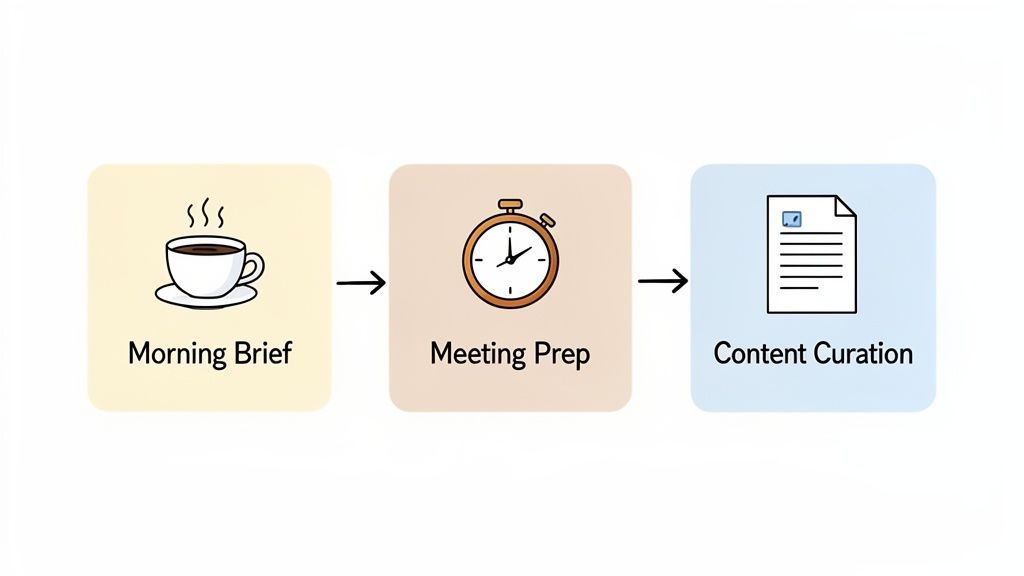
These workflows are designed to turn raw information into a real-world advantage with almost zero friction.
The Morning Intelligence Briefing
Start your day ahead of the competition. Instead of scrolling news headlines, take 15 minutes to review AI summaries from key industry podcasts published overnight. This simple switch arms you with the latest strategies and market chatter from top minds in your field.
This workflow is simple and powerful:
- Pick Your Sources: Curate a list of 5-10 must-listen podcasts for your niche.
- Set Up Automation: Use a tool like PodBrief to automatically generate notes for every new episode.
- Scan and Synthesize: Read the briefs with your morning coffee. Boldly highlight the top three insights that could shape your day.
This turns a quiet morning ritual into a strategic intelligence session. You get fresh perspectives before your first meeting even begins.
Just-in-Time Meeting Preparation
Walk into every meeting completely prepared. Before a big client call, generate a summary of a relevant podcast episode—perhaps one featuring an expert on the topic. This gives you instant access to sharp talking points and recent data.
Have a client meeting in 30 minutes? Find a recent interview with that company's CEO, run it through your tool, and in five minutes you’ll have their core value proposition in front of you. This "just-in-time" learning is a huge advantage.
This approach shifts meeting prep from a frantic scramble into a focused, five-minute intelligence download. You walk in with more confidence and credibility.
Building a Personal Knowledge Base
Real expertise is built by consistently capturing and connecting ideas. As you review summaries, organize the most valuable takeaways. Over time, this curated library becomes your searchable, personal database of expert knowledge.
This is more important than ever. The podcast market is on track to hit USD 131.13 billion by 2030, with an audience over 464 million listeners. Without a system to capture good ideas, you’re letting a river of knowledge flow past you. You can read more about the global podcasting market trends to see how big this is.
A simple workflow for this looks like this:
- Tag Everything: After reading a summary, add relevant tags (e.g., "Leadership," "AI Strategy," "Q3 Competitor Intel").
- Archive It: Save the tagged notes in a dedicated folder or your favorite note-taking app.
- Review Periodically: Once a month, scan your archives. You’ll start to spot emerging trends and connect new ideas.
This disciplined process ensures the intelligence you gather doesn't disappear. A tool like PodBrief makes this incredibly easy by keeping all your briefs in a personal, searchable library.
Where Do You Go From Here?
Automated podcast notes are more than a neat trick. They are an indispensable tool for anyone serious about staying ahead. You're tapping into the minds of top experts, and AI is distilling their most valuable insights for you.
This is your chance to make your listening time count. Instead of just hearing hours of conversation, you can absorb core knowledge and translate it into a competitive edge. The choice is yours.
You can let valuable information wash over you, or you can start actively capturing and using it. Making that shift from passive listening to strategic learning is how you get ahead. It’s about turning a flood of audio into actionable intelligence.
Ready to see the difference for yourself? Try PodBrief for free today and get an AI briefing of the topics mentioned in this article.
Your Questions Answered
Let's tackle common questions about automated podcast notes. My goal is to give you straight answers so you know exactly what this tech can—and can’t—do.
How accurate are the AI-generated notes?
It depends on the service. The accuracy reflects the quality of the AI. The best tools are impressively accurate, but no AI is flawless.
A few things can affect the output:
- Audio Quality: Cleaner audio produces better results. Studio recordings with minimal background noise are ideal.
- Speaker Clarity: Heavy accents, rapid talking, or mumbling can sometimes trip up the transcription AI.
- Technical Jargon: Niche terminology might occasionally be misinterpreted if the AI hasn't encountered it before.
Realistically, you should expect 90-95% accuracy from a top-tier service. That’s more than enough to grasp the main ideas and takeaways. If you're pulling a specific statistic for a report, it's always smart to double-check it.
Can I just stop listening to podcasts altogether?
For many busy professionals, the answer is yes. The point of automated podcast notes isn't to replace entertainment. It's about efficiently mining the intelligence inside the audio. If your goal is to extract main arguments and strategic insights, a summary is often more effective.
Think of it this way: you can sit through an hour-long meeting or read the two-page executive briefing. Both give you the necessary information, but the brief gets you there in a fraction of the time.
For strategic learning and intelligence gathering, AI notes aren't just a replacement; they are an upgrade. They filter the signal from the noise, letting you consume more knowledge in less time.
Is my data safe when I use these tools?
This is a valid and important concern. When you use a service, you are placing trust in that company. Any reputable provider understands this and has clear, transparent policies.
Before signing up, check their privacy policy. Look for answers to these questions:
- How is my data used? Does the company use your audio to train its AI models? Can you opt out?
- Where is my data stored? Is it kept on secure, encrypted servers?
- Who can access my data? What internal controls does the company have?
A trustworthy service will be upfront about data handling. At PodBrief, we make user privacy a top priority, ensuring your content is kept secure and confidential.
How long does it take to get my notes?
Speed is a major benefit. Manually noting a one-hour episode takes at least an hour, plus organizing time. AI tools blow that workflow away.
Most leading services can process a typical hour-long podcast and return a full summary in just a few minutes. This speed enables new workflows, like getting a brief on a topic minutes before a call. The time savings are massive.
Stop drowning in audio content and start mastering it. PodBrief provides the executive briefings you need to absorb key insights in minutes. Transform your listening habits from passive consumption to active intelligence gathering.
Try PodBrief for free and get your first AI-powered brief today.


