
Want to understand relativity or quantum mechanics without committing to a full degree? YouTube makes that possible, but most lists of the best youtube channels for physics miss a key problem. Time is the constraint, not access. The wrong channel can leave you with slick visuals, weak explanations, and no usable understanding.
This guide is built for efficiency. It gives you the best youtube channels for physics based on learning goal, depth, and time-to-insight. Some channels are ideal for fast concept refreshers. Others are better when you want a serious, lecture-level deep dive.
If you're actively studying mechanics, pair these channels with focused problem work like these physics kinematics practice problems. That combination works better than passive watching alone.
One more practical point. Long science videos are useful, but they can turn into a time sink fast. PodBrief's role is natural here. If a channel publishes dense explainers, interviews, or long lectures, you can summarize the video first, decide if it's worth the full watch, and keep the key points in a searchable library.
1. Veritasium
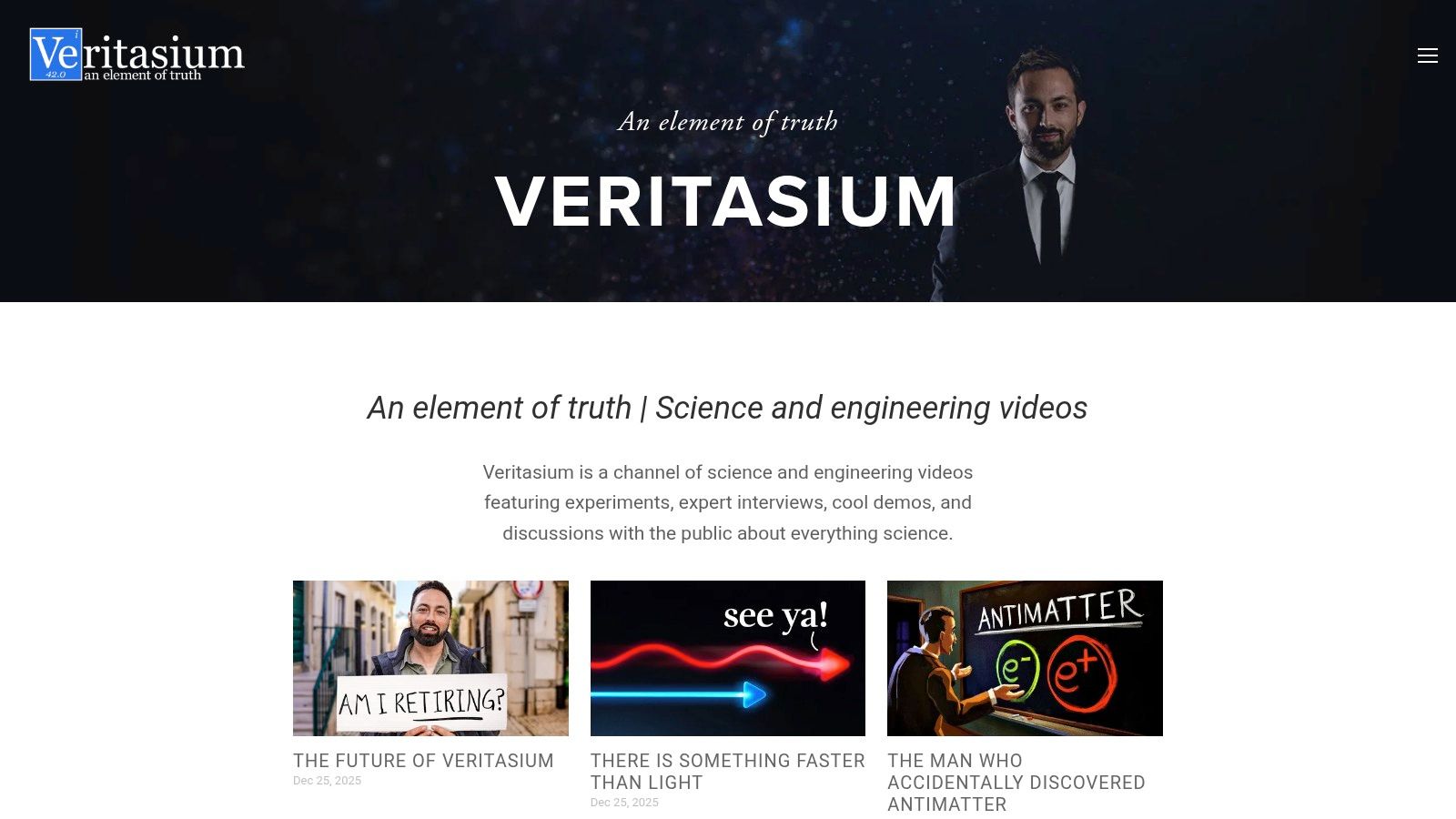
Best for conceptual clarity with real experiments. If you want physics that sticks, start with Veritasium. Derek Muller is strong at taking a concept that looks settled on paper and showing why people misunderstand it in practice.
This channel works best for curious adults, high school students, undergrads, and professionals who want more than a surface explanation. It doesn't feel like a classroom replay. It feels like evidence-led problem solving.
Direct link: Veritasium
Why Veritasium earns a top spot
Veritasium is strongest when physics gets counterintuitive. Electricity, motion, thermodynamics, measurement, causality, and common misconceptions all fit its format well. You don't just hear the claim. You see the setup, the experiment, and the reasoning.
That matters because many learners don't struggle with formulas first. They struggle with the mental model underneath the formula. Veritasium fixes that better than most channels.
A second advantage is range. The channel regularly crosses from pure physics into engineering and scientific reasoning. That's useful if you want a broader scientific instinct, not just exam recall.
Practical rule: Use Veritasium when you're confused about why a result is true, not just what the result is.
If you want more science creators in the same general quality bracket, PodBrief also has a useful list of best science channels on YouTube.
Best use case and time payoff
Expect longer videos than a quick whiteboard channel. That's the tradeoff. You spend more time per topic, but you usually leave with fewer conceptual gaps.
Use Veritasium for:
- Course support: Watch after class when the lecture felt too abstract.
- Self-study: Use it before opening a textbook chapter you already know will be dense.
- Teaching prep: Instructors can mine episodes for demos, misconceptions, and framing ideas.
PodBrief is especially useful here. Summarize the episode first. If the brief matches your goal, watch the full video. If not, skip it and move on. That's the right workflow for busy learners.
2. MinutePhysics
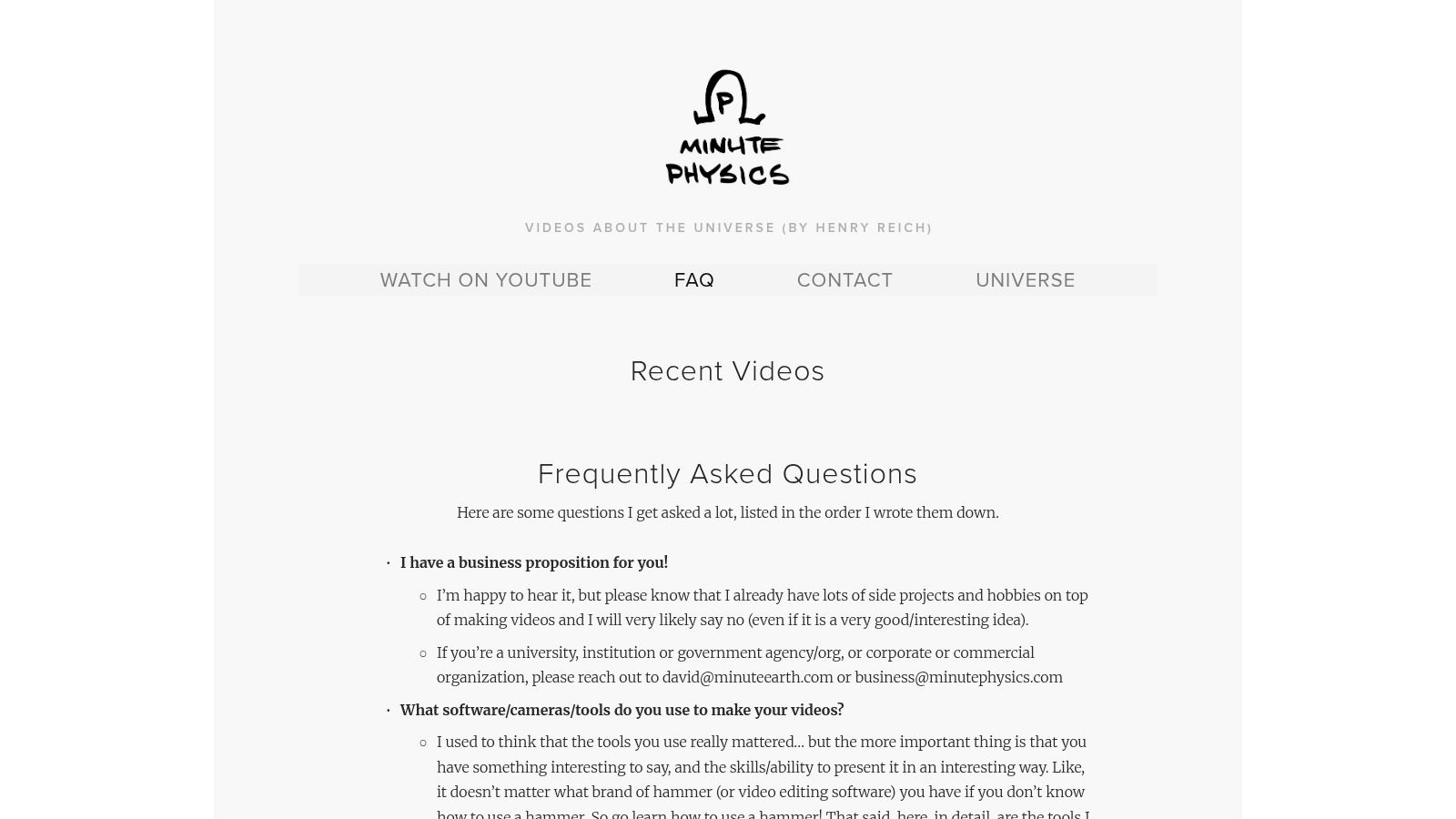
Need a fast answer before you commit an hour to a harder video? Start with MinutePhysics.
Henry Reich built one of the most efficient physics channels on YouTube. The formula is simple: hand-drawn sketches, tight narration, and a clear idea per video. For a busy learner, that matters more than production polish. You get the concept quickly, and you can decide whether the topic deserves deeper study.
Direct link: MinutePhysics
Why it earns a spot on this list
MinutePhysics is a filter. Use it to test whether a topic has clicked at the intuition level before you spend time on equations, lectures, or longer explainers.
That makes it especially useful for early-stage understanding. Relativity, quantum mechanics, cosmology, symmetry, and gravity all fit the channel well because the videos focus on the core mental picture first. You will not get a full treatment. You will get enough structure to stop feeling lost.
That is the strategic value of this channel in a serious study stack. Veritasium is stronger for extended conceptual investigation. PBS Space Time is better once you want rigor and continuity. MinutePhysics handles the gap before both. It gives you a fast read on whether you understand the idea well enough to move on.
Best audience and time-to-insight payoff
MinutePhysics is the right pick for:
- Students who need a pre-lecture primer: Watch one video before class so the formal presentation lands faster.
- Professionals relearning physics: Use it to rebuild intuition without committing to a full course.
- Curious generalists: Sample a topic in minutes and decide if it deserves deeper attention.
The payoff is speed. In one short session, you can usually answer a practical question: "Do I understand the shape of this idea yet?" That is a high return for anyone studying in small blocks.
For broader low-friction learning habits outside video, PodBrief also has a useful guide to podcasts for learning while multitasking.
With PodBrief, the smart workflow is to summarize a full MinutePhysics playlist, then group related videos into one set of notes. That turns scattered short explainers into a usable review document. For busy people, that is the difference between casual watching and actual retention.
3. PBS Space Time
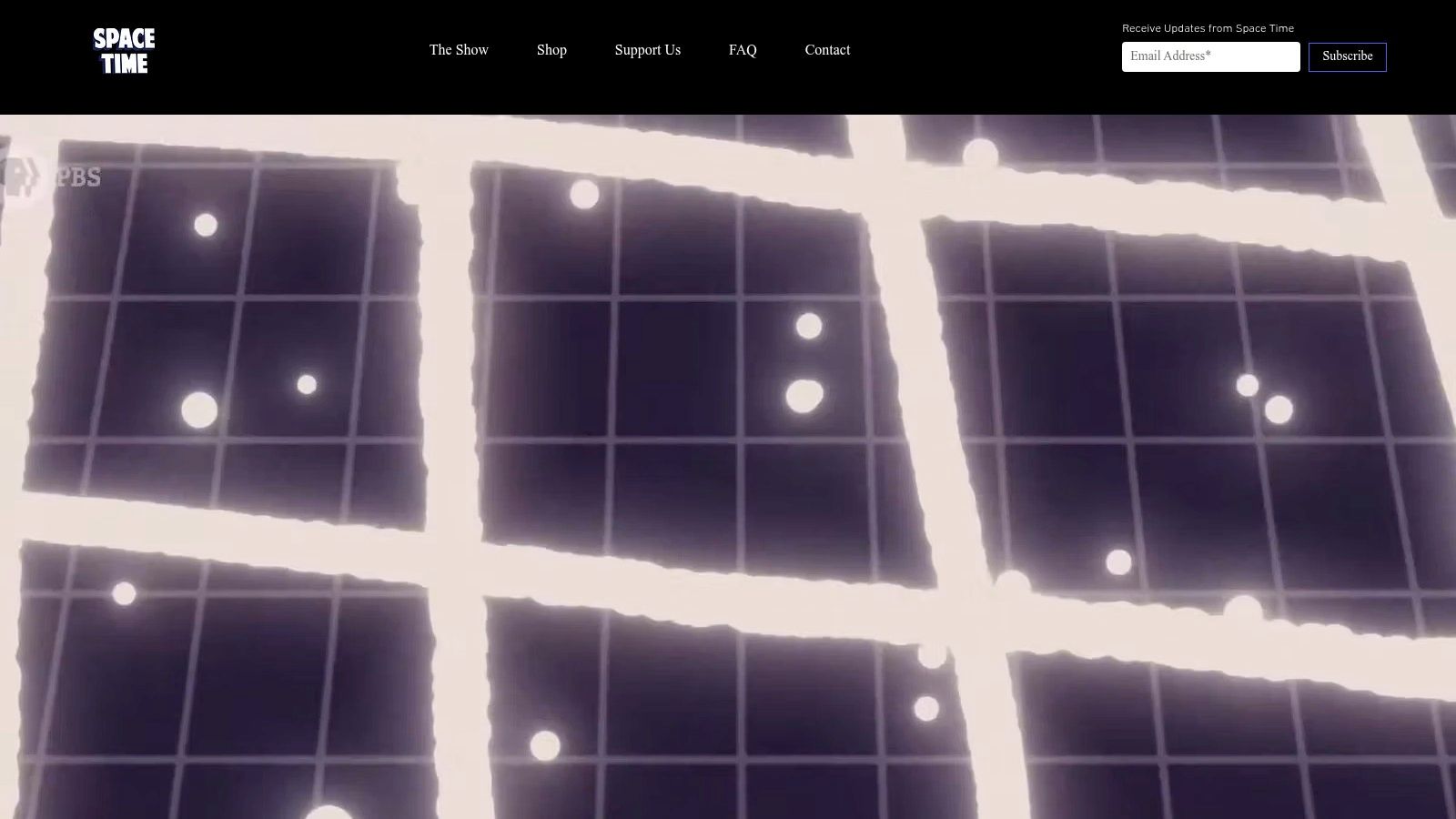
PBS Space Time is where you go when "popular science" stops being enough. This channel doesn't just explain astrophysics and theoretical physics. It builds ongoing topic sequences that demand attention and reward it.
If you're an undergrad, grad student, technically strong hobbyist, or researcher outside physics who wants a serious overview, put this channel near the top of your list.
Direct link: PBS Space Time
Why it stands out
Most science channels optimize for accessibility first. PBS Space Time pushes further into rigor. It covers black holes, cosmology, quantum fields, spacetime, and related foundations in a way that feels closer to a structured seminar than a viral explainer.
That makes it one of the most useful channels for people who already know the basics and want continuity across episodes. The playlists matter here more than individual videos. You learn faster when one episode builds directly on the last.
Its main drawback is also its strength. It assumes effort from the viewer. If your algebra and conceptual footing are weak, the channel can feel fast.
Who should use it and how
PBS Space Time pays off when your goal is depth, not speed. Use it when you want to connect ideas across a whole subfield rather than memorize isolated facts.
A practical workflow:
- Start with a playlist, not a random episode: The sequencing is part of the value.
- Pause often: This isn't background content.
- Take one concept at a time: Especially in cosmology and quantum topics.
If you prefer long-form educational listening in parallel, PodBrief's guide to best podcasts for learning covers adjacent options.
Use case: Treat PBS Space Time like a compact online course, not like casual YouTube.
PodBrief helps most before you begin. Summarize the first episode in a series. If the brief shows the topic is at the right level, commit. If not, drop down to MinutePhysics or Physics Girl first, then come back later.
4. Physics Girl
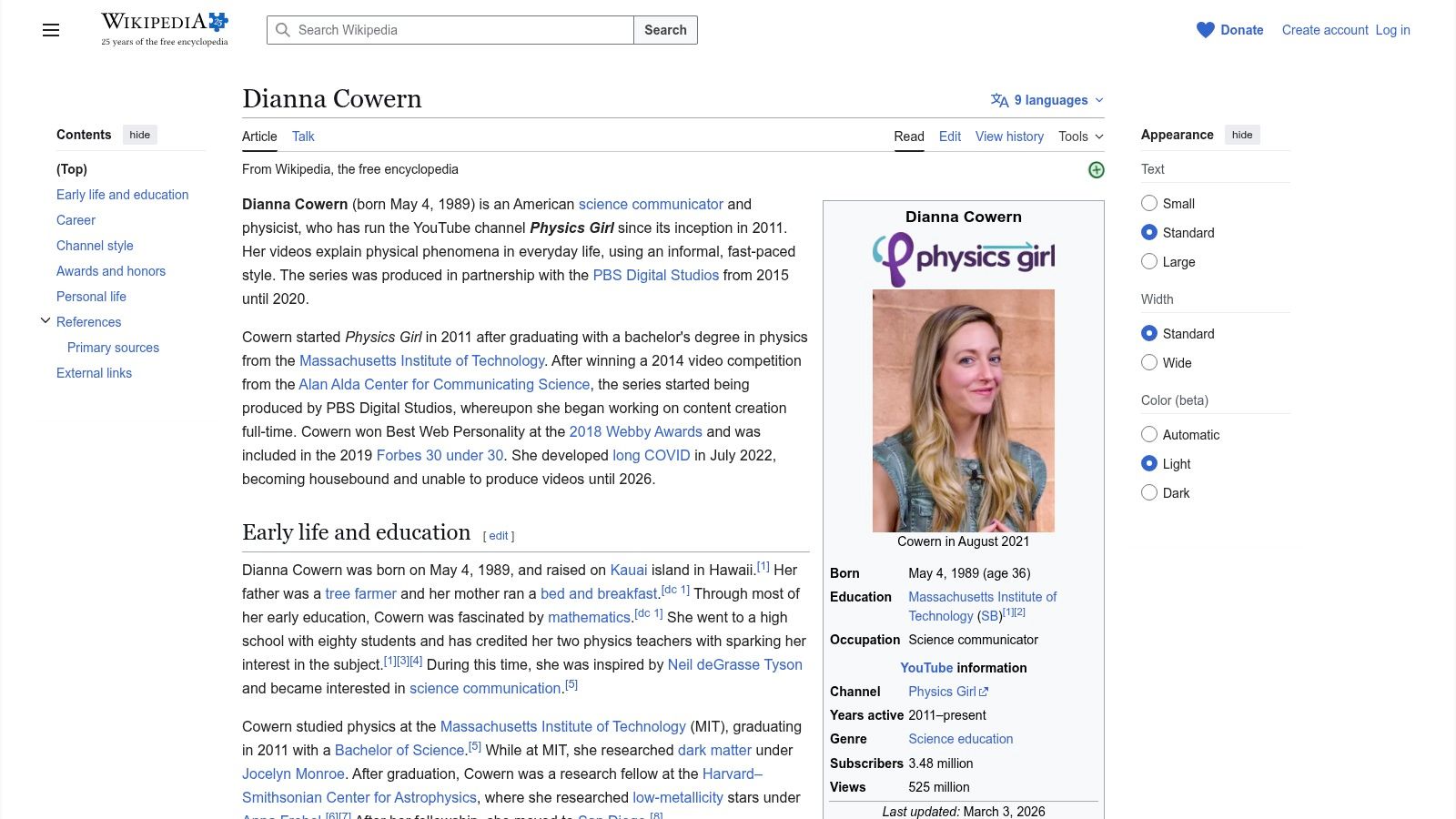
Need a physics channel that gets someone interested fast, without dropping standards? Start with Physics Girl.
Dianna Cowern is the strongest pick on this list for beginners who need curiosity before rigor. Her videos make physical ideas visible through experiments, demonstrations, and concrete examples. That matters because early progress in physics depends less on raw difficulty and more on whether the subject feels worth sticking with.
This is the right channel for high school students, teachers, parents, and adults returning to science after a long break.
Direct link: Physics Girl on YouTube
Why Physics Girl earns a spot on this list
Physics Girl works because it turns abstract concepts into things you can watch happen. That makes the channel efficient for first contact with a topic. You get the core idea quickly, and you usually remember it because the explanation is tied to a physical event, not just a definition.
That also makes it useful in a strategic learning stack. Use Physics Girl at the start of the process, when your goal is to get oriented in 10 to 15 minutes and decide whether a topic deserves more study. If the answer is yes, move to a faster conceptual channel like MinutePhysics or a more demanding one like PBS Space Time, depending on how much depth you need.
One more advantage. The channel is unusually good at reducing intimidation.
Best for motivation, demos, and re-entry learning
Choose Physics Girl when motivation is the bottleneck, not content volume.
Use it for:
- Building interest fast: Good for viewers who bounced off textbook-style explanations.
- Classroom examples: Teachers can pull practical demos that stick.
- Re-entry learning: Adults can rebuild confidence before returning to more technical material.
The tradeoff is clear. Physics Girl is not where you go for the tightest mathematical treatment. It is where you go to get traction, spot the intuition, and create enough momentum to keep learning.
Use case: If you are busy and want a high time-to-insight payoff, start here when a topic feels abstract or stale.
PodBrief is useful after longer, conversational, or collaboration-heavy episodes. Pull out the main scientific takeaway, the experiment setup, and any terms worth reviewing later. That gives you usable notes without rewatching the whole video.
5. Science with Sabine
Science with Sabine is for people who are tired of hype. Sabine Hossenfelder doesn't package physics as endless wonder. She stresses where evidence ends, where speculation begins, and where public science coverage oversells the story.
That makes this channel unusually valuable for advanced learners and working professionals who want a cleaner filter for research-adjacent claims.
Direct link: Science with Sabine
Best for critical thinking about modern physics
A lot of channels explain accepted ideas. Fewer channels interrogate how claims are framed. Science with Sabine does that well, especially around quantum foundations, cosmology, particle physics, and trendy "breakthrough" headlines.
If you read science news and often suspect the headline is stronger than the underlying result, this channel gives you a better review process. The tone is direct. That's a feature, not a bug.
You should use this channel after you have some baseline literacy. Complete beginners may misread skepticism as cynicism. More experienced viewers will recognize the value immediately.
When to choose Sabine over other channels
Pick Science with Sabine when the goal is judgment, not first exposure.
- Use Veritasium when you need conceptual intuition.
- Use MinutePhysics when you need a fast primer.
- Use PBS Space Time when you want structured depth.
- Use Sabine when you want to assess whether a claim deserves your attention at all.
That last function is underrated. Good filters save more time than good explanations.
Decision rule: If a topic is prominent on your feed and seems groundbreaking, run it through Sabine before you trust the summary headlines.
PodBrief fits well here because these videos often contain layered arguments. A structured summary gives you the premises, the objection, and the final conclusion in one place. That's useful if you're comparing multiple viewpoints or referencing the argument later in discussion or writing.
6. Sixty Symbols
Sixty Symbols feels like office hours with working physicists. It doesn't always chase polish. That's part of the appeal. You hear from researchers, often in academic settings, talking through symbols, concepts, instrumentation, and real scientific work.
For undergrads and serious hobbyists, that's a strong complement to textbook learning.
Direct link: Sixty Symbols
Why Sixty Symbols is different
Most YouTube science channels are built around one host and one presentation style. Sixty Symbols is broader and more academic in texture. You get many contributors, many topics, and many levels of detail.
That creates a different kind of value. Instead of one clean content arc, you get access to how physicists talk, frame problems, and connect ideas to research culture. It humanizes the subject without making it simplistic.
The downside is obvious. The catalog is wide, not tightly organized, and the production style varies. You may need to search with intent instead of browsing casually.
Best use for students
Sixty Symbols works best as a supplement, not a primary curriculum. It fills in the context formal courses often miss.
Use it when you want:
- Symbol-level clarity: Videos centered on notation, terminology, and conceptual framing.
- Academic context: A feel for how researchers discuss the topic outside a lecture hall.
- Breadth across subfields: Particle physics, astrophysics, and related topics all show up.
A good way to use the channel is to pair it with your syllabus. Search for the exact idea you're studying, then watch one or two videos to build context around the formal material.
PodBrief is especially practical here because the catalog is large and unevenly structured. Summarize a few candidate videos on the same concept, compare the briefs, then watch the one that best matches your level. That turns a sprawling archive into a usable study tool.
7. Fermilab
Want the channel with the highest signal for particle physics? Start with Fermilab.
Fermilab is the strongest pick here for viewers who care less about polished edutainment and more about how modern physics gets explained inside a major research institution. The value is straightforward. You get talks, lab-produced explainers, research context, and public-facing material tied directly to real experimental work.
If you care about neutrinos, accelerators, detectors, or the Standard Model, put this channel in your serious-study rotation.
Direct link: Fermilab social media and channel hub
Why Fermilab belongs here
Fermilab gives you institutional context that creator-led channels usually cannot. That matters because particle physics is easy to oversimplify. Fermilab's videos are more likely to show how the field is structured, what experiments are trying to measure, and why certain questions still matter.
The tradeoff is time-to-insight. You will not always get a fast payoff in the first three minutes. Many of the strongest videos are lectures, panel discussions, or detailed explainers that demand focus. For a busy professional, that is a feature if you choose the channel for the right job.
Use Fermilab when your goal is accuracy and research context, not quick intuition.
Best for advanced learners and focused professionals
This channel fits advanced undergraduates, graduate students, engineers, analysts, and technically curious professionals who want a cleaner view of high-energy physics than pop-science summaries usually provide.
Use Fermilab when you want:
- Research-proximate explanations: Content shaped by a working national lab, not just public science commentary.
- Facility and experiment context: Better understanding of detectors, beamlines, collaborations, and what large experiments involve.
- High payoff for specialized topics: Strong value if you already know the basics and need substance fast.
A practical framework works well here. If you are new to particle physics, use a faster channel first to get the vocabulary. If you already know the vocabulary, go straight to Fermilab for the higher-quality explanation.
PodBrief is useful for this specific channel because the time cost is often high. Summarize a lecture first, check whether it matches your learning goal, then decide whether the full watch is worth the hour. That makes Fermilab a strong channel for busy people, not just full-time students.
Top 7 Physics YouTube Channels, Side-by-Side Comparison
| Channel | 🔄 Implementation Complexity | ⚡ Resource Requirements | 📊 Expected Outcomes (⭐) | Ideal Use Cases | 💡 Key Advantages |
|---|---|---|---|---|---|
| Veritasium | Medium, well-structured experiments and interviews | Moderate, typical videos 20–30 min, requires focused viewing | High conceptual clarity and evidence-based explanations ⭐⭐⭐⭐ | Course supplements, deep conceptual dives, self-study | Strong experiments, expert sourcing, myth-busting |
| MinutePhysics | Low, concise whiteboard explainers; minimal setup to consume | Low, videos under 5 minutes, very quick to watch | Rapid intuition and memory retention; limited mathematical depth ⭐⭐⭐ | Quick refreshers, pre-lecture primers, busy learners | Ultra-concise visuals that aid fast concept acquisition |
| PBS Space Time | High, math-heavy, multi-episode series requiring steady effort | High, long episodes and series, requires pausing and review | University-level, rigorous understanding of advanced topics ⭐⭐⭐⭐⭐ | Advanced study, undergrad/grad coursework, semester-length study | Systematic playlists, equations, and deep conceptual rigor |
| Physics Girl | Low–Medium, demo-driven, approachable production | Moderate, ~10 min demos that engage and inspire | Strong engagement and motivation; excellent for sparking interest ⭐⭐⭐⭐ | High-school outreach, classroom demos, general curiosity-driven learning | Hands-on demonstrations and inclusive outreach style |
| Science with Sabine | Medium, critical, argument-focused content needs thoughtful listening | Moderate, ~15 min analysis pieces; benefits from background knowledge | Improved critical filtering of claims; nuanced perspective on research ⭐⭐⭐⭐ | Graduate students, researchers, skeptical consumers of science news | Clear distinction between consensus and speculation; methodological focus |
| Sixty Symbols | Medium, researcher-led interviews and lab segments, variable depth | Variable, short to medium videos; catalog is broad so searching helps | More humanized, contextual understanding of academic practice ⭐⭐⭐ | Undergraduates seeking behind-the-scenes academic context and examples | Authentic researcher perspectives, lab tours, connection to teaching culture |
| Fermilab | High, lecture- and seminar-level material from active researchers | High, hour-long lectures and seminars; significant time investment | Authoritative, primary-source depth appropriate for professionals ⭐⭐⭐⭐⭐ | Advanced undergrads, grad students, physics professionals | Direct access to national-lab research, seminar- and colloquium-level content |
Turn Video Lessons into Actionable Knowledge
Want these channels to teach you physics faster, not just fill your watch history?
Use them like a system. Each channel does a different job, and the payoff depends on matching that job to your goal and your available time. If you need a fast intuition check, use MinutePhysics. If you need a structured push into harder concepts, use PBS Space Time. If you want source-level depth in particle physics, go straight to Fermilab.
That choice matters because time-to-insight is different across the list. Veritasium often pays off in one strong idea you will remember. Physics Girl pays off quickly when you need a concrete demonstration that makes an abstract concept stick. Science with Sabine is best for pressure-testing claims and separating solid reasoning from hype. Sixty Symbols helps when you want to understand how physicists talk, teach, and work.
Use a simple workflow:
- Pick the learning goal first: quick intuition, structured study, skepticism check, or research context.
- Choose the channel that fits that goal: don't spend an hour on a lecture when a six-minute explainer will do the job.
- Decide the payoff you want: one key concept, one equation, one objection, or one practical example.
- Save the takeaway immediately: a short note, a summary, or a review prompt is enough.
This workflow is a natural fit for PodBrief. It turns long YouTube videos into concise summaries you can read or listen to. That is especially useful with physics, where the format is often inefficient for busy learners. Some videos are too short and fragmented. Others are packed with value but too long to process in one sitting.
A good example: preview a Fermilab lecture with a summary before you commit the full hour. Or combine several MinutePhysics episodes into one review brief so the ideas stop living in separate tabs.
Its advantage shows up across channels. Veritasium may give you the intuition. PBS Space Time may give you the formal structure. Science with Sabine may expose the weak assumptions. Once those takeaways are captured in one place, you can compare ideas instead of rewatching videos.
If you want better retention, pair watching with problem-solving, note review, and selective summarization. For problem practice, focused resources like turn any YouTube video to notes can also help you think more actively about what you're watching.
The practical takeaway is simple. Don't ask which channel is best in the abstract. Ask which channel gets you the next useful insight in the least time. That is how this list becomes a learning strategy instead of another roundup.