
How to Summarize Long-Form Podcasts: An Executive's Guide

Summarizing a long-form podcast transforms hours of audio into powerful, actionable insights. The process is simple. Find a valuable episode, get a clean transcript, and extract the core ideas. This shifts you from passive listening to actively building your knowledge base.
Why Summarizing Podcasts is Non-Negotiable for Busy Professionals
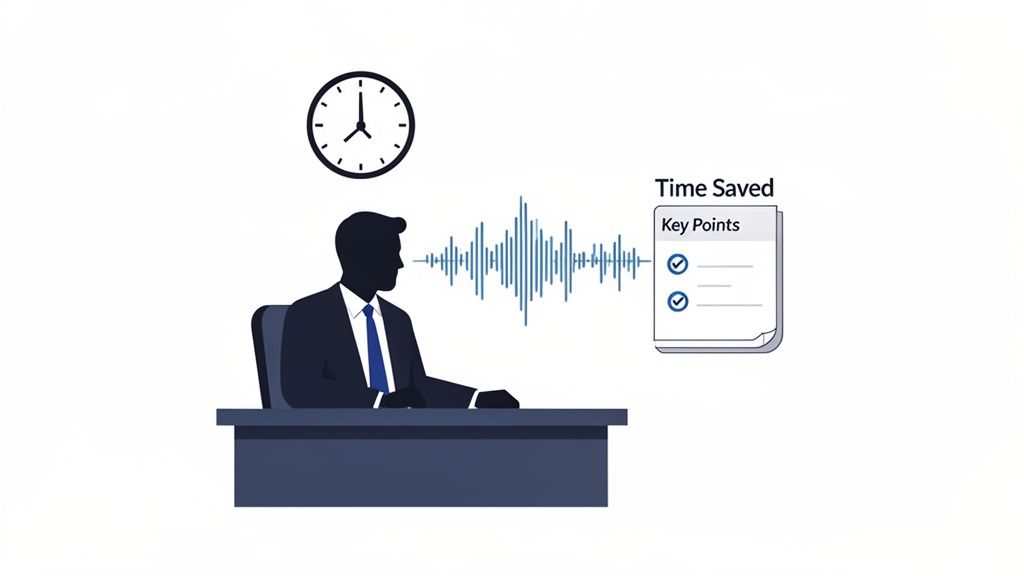
Long-form podcasts are free consulting sessions. They offer deep dives into market trends, leadership, and innovation from industry leaders. But for any busy professional, the time commitment is a major obstacle.
The problem isn't a lack of content—it's an overabundance. This creates "content debt," a growing backlog of episodes you never get to. Summarizing podcasts is the most effective way to clear that debt.
The Power of Distilled Insights
This isn't about cutting corners. It's a strategic filter. You isolate the critical 10% of a conversation that holds 90% of the value. This turns hours of listening into minutes of focused reading, letting you absorb knowledge from multiple sources without disrupting your day.
Time is the biggest barrier. The average podcast listener spends about seven hours a week tuned in, according to recent podcast statistics. For an executive, that's unrealistic. A solid summary turns a 60-minute episode into a five-minute brief with everything you need.
Adopting this system delivers immediate wins:
- Reclaim Your Time: Get hours back each week by focusing only on essential information.
- Boost Your Recall: You remember more from concise notes than from passively listening.
- Get Actionable Insights: Quickly identify and apply the strategies discussed.
- Sharpen Your Edge: Consume targeted information faster than your competition.
Mastering this makes you an active builder of expertise, not a passive consumer. Every minute counts.
Preparing a Podcast for a High-Value Summary
A great summary starts before you press play. Proper preparation separates a sharp, actionable brief from a pile of messy notes. A little groundwork ensures your time is well spent.
It all comes down to your "why." Before choosing an episode, be clear on your objective. Are you researching market trends? Leadership tactics? Competitor intelligence? A clear goal prevents you from wasting time on irrelevant content.
Start With Your Goal
Your objective is a filter. It helps you focus on relevant details and extract important nuggets with precision. When your goal is clear, you can cut through the noise.
Common executive goals include:
- Competitor Intel: Pinpointing a rival CEO's product strategy or market position.
- Market Research: Extracting data, trends, and forecasts to guide a business decision.
- Skill Building: Isolating specific, actionable tips on negotiation or team management.
- Pre-Meeting Briefing: Getting smart on a new industry before a key meeting.
Nailing down your "why" is the most important step. It turns passive listening into an active hunt for intelligence.
Choose the Right Episode
Once your objective is set, find the right episode. Never commit to an hour-long podcast without a quick screening. A five-minute check can save you an hour of wasted time.
Here’s a quick checklist to vet an episode:
- Title and Description: Do they match the keywords or topics you need?
- Guest's Background: Is the guest a credible expert with relevant experience? A quick LinkedIn check helps.
- Show Notes & Timestamps: Scan the outline for your keywords to confirm the content is a match.
This simple check is your best defense against investing time in a dead-end episode.
Get a Clean Transcript
The final preparation step is securing a solid transcript. The transcript is your raw material, and its quality directly impacts your summary. You can't summarize what you can't read.
A transcript riddled with errors forces you to constantly cross-reference the audio. This defeats the purpose of saving time.
You have two main options: automated services or manual cleanup. AI transcription is fast and affordable but can struggle with accents, jargon, or crosstalk. A good approach is to use an AI service and then perform a quick human review to fix key terms. Learning how to translate audio to text is a valuable first step.
Structure Your Summary and Extract Key Insights
You have a clean transcript. Now it's time to turn raw words into a high-impact brief. Without a solid framework, you'll just create a shorter wall of text, defeating the purpose.
The goal isn't just to shorten the content. It's to strategically extract the most valuable ideas. A structured approach makes the final summary truly useful.
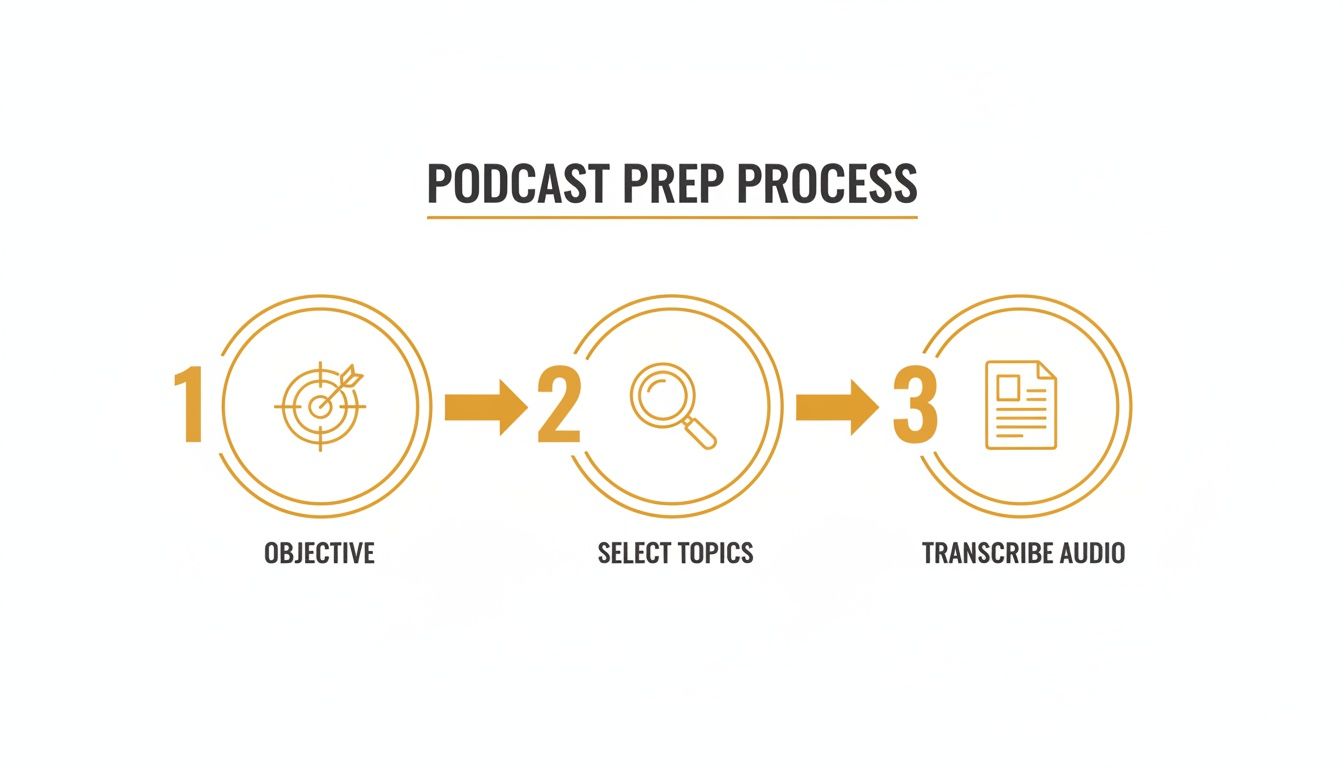
A quality summary is the final step in a deliberate workflow. It starts with knowing why you're listening.
The Executive Brief: A Simple, Powerful Template
Use a repeatable template for every summary. This forces you to organize information into clear, scannable categories.
Here's a structure that works for almost any professional context:
- Top 3-5 Core Ideas: The big-picture concepts or foundational arguments of the conversation.
- Actionable Takeaways: Specific strategies, tips, or advice you can use immediately.
- Notable Quotes: Powerful, memorable lines perfect for presentations or team updates.
This format provides an at-a-glance overview that gets straight to the point.
Manual vs. AI-Powered Summarization: Choosing Your Path
You have a template. Now, how do you fill it? You can do it by hand or use AI to accelerate the process. The right choice depends on your need for control versus your available time.
Comparing Manual vs AI-Powered Summarization
This table offers a direct comparison to help you choose the best summarization method for your workflow.
| Feature | Manual Summarization | AI-Powered Summarization |
|---|---|---|
| Control | Total control over tone, nuance, and selected insights. You decide what's important. | Limited by the AI's interpretation and the quality of your prompt. |
| Speed | Very slow. Can take hours for long episodes. | Extremely fast. Delivers a summary in seconds or minutes. |
| Nuance | Excellent. You can pick up on sarcasm, subtle context, and unspoken implications. | Variable. Can miss subtext or misinterpret tone. |
| Cost | "Free" but costs you significant time and focus. | Varies from free tools to paid services, but saves immense time. |
| Effort | High. Requires deep listening and critical thinking throughout. | Low. Requires a well-crafted prompt and a final review. |
| Consistency | Can vary based on your focus and energy levels. | Highly consistent output based on the same prompt. |
Manual summarization gives you the most control. You read the transcript, flagging key themes and catching subtle insights an algorithm might miss. This method is best when nuance is critical, like analyzing a competitor's tone. The downside is the significant time investment.
This is where AI tools make a difference. An AI podcast summarizer dramatically reduces the time needed to condense a transcript. The trick is guiding the AI effectively.
The key to great AI summarization isn't the tool—it's the quality of your instructions. Vague prompts give you useless summaries.
Don't just ask the AI to "Summarize this podcast." Instead, get specific. Try a prompt like this:
"Analyze the attached transcript from the [Podcast Name] episode with [Guest Name]. Structure the output as an executive brief with three sections: 'Core Ideas,' 'Actionable Takeaways,' and 'Notable Quotes.' Focus on insights related to Q4 market trends and B2B sales strategies."
This level of detail turns a generic tool into a powerful assistant. For professionals who need to move even faster, a service like PodBrief automates the entire workflow. It handles transcription, cleaning, and summarization, delivering a high-quality brief without requiring prompts.
Polish and Operationalize Your Summary
A raw summary is a first draft. The final step is turning it into a usable asset. This involves a quick quality check and formatting the information for its intended purpose. This last pass transforms information into actionable intelligence.
Perform a Quick Quality Check
Give your summary a quick review. This is a high-speed check for accuracy and clarity, not a line-by-line edit. Ensure the summary faithfully captures the speaker's intent.
Here's what to scan for:
- Accuracy: Are the main arguments and data points correct?
- Clarity: Is the language direct and easy to understand? Remove jargon.
- Conciseness: Does every sentence add value? Cut the filler.
Don't skip this. An inaccurate summary is worse than no summary at all.
Pick the Right Format for the Job
Format the summary based on its use case. A simple text file isn't always best. Match the output to your objective.
Consider these common formats:
- Text Document: Ideal for personal archives or detailed reports.
- Bulleted List: Perfect for presentation slides or pre-meeting briefing docs.
- Audio Brief: A great way to review key takeaways during a commute.
Choosing the right format makes the information easier to use when you're in a hurry.
Build Your Personal Knowledge Library
A single summary is useful. A searchable collection is a strategic advantage. The real power comes from building a personal knowledge library you can access anytime.
This is how you turn the overwhelming podcast landscape—with its 4.5 million shows and 175 million episodes—into a manageable resource. You can find more podcast statistics at Podcaststatistics.com. By curating your own database, you filter the noise.
Use tools like Notion or Evernote to store and organize your briefs. The key is proper tagging.
Tagging your summaries with keywords like 'Q3 planning,' 'competitor analysis,' or 'leadership' transforms a simple archive into a dynamic, searchable database.
With a well-organized library, you can pull up exactly what you need in seconds. This turns passive listening into a powerful, long-term knowledge management habit.
Advanced Summarization Techniques for Power Users
Once you have a system for single episodes, it's time for higher-leverage strategies. This is where you move from note-taking to building an intelligence engine for your team. You're graduating from personal productivity to creating a scalable knowledge base.
Go Thematic with Your Summaries
Instead of analyzing one episode at a time, thematic summarization pulls insights from several episodes on a single topic. For example, to research AI's impact on supply chain management, you might analyze five different expert interviews.
The goal is to build one consolidated brief that synthesizes all key arguments and data points. This gives you a richer, more nuanced understanding than any single episode can offer.
This approach is a game-changer for:
- Deep Research: Get up to speed on a new industry or technology quickly.
- Trend Spotting: Identify recurring patterns by comparing expert opinions.
- Content Creation: Build a foundational document for a white paper or strategic plan.
Tailor Summaries for Different Audiences
A one-size-fits-all summary rarely works. A CEO needs different insights than an operations manager. By creating summaries with different ‘lenses,’ you can tailor information for specific audiences, making it infinitely more useful.
A high-level brief for the C-suite is about the 'why.' A tactical brief for an operational team is about the 'how.'
For example, a podcast on a new marketing platform can yield two distinct briefs from the same transcript.
Example AI Prompts for Audience-Specific Summaries
- For the C-Suite: "Analyze this transcript and create a one-page strategic brief. Focus on ROI, competitive advantages, and long-term market implications. Omit tactical details."
- For the Marketing Team: "From this transcript, extract a tactical summary focused on implementation. List tools mentioned, step-by-step processes, and operational challenges. Include all actionable tips."
A powerful AI podcast summarizer is perfect for generating these custom outputs quickly.
Plug Summaries Directly into Your Workflow
The final step is integrating this intelligence into your team's existing systems. A summary sitting in your personal notes is a missed opportunity. Make these insights accessible and actionable for everyone.
Weave your summaries into platforms your team already uses:
- Link a summary to a relevant task in Asana or a ticket in Jira.
- Embed briefs into your team’s wiki on Confluence or a database in Notion.
- Share key takeaways in a dedicated Slack or Teams channel to spark conversation.
This turns a personal productivity hack into a shared resource that builds a culture of continuous learning.
From Listening Overload to Actionable Knowledge
Let's be realistic. Manual and semi-automated workflows still demand your most limited resource: time.
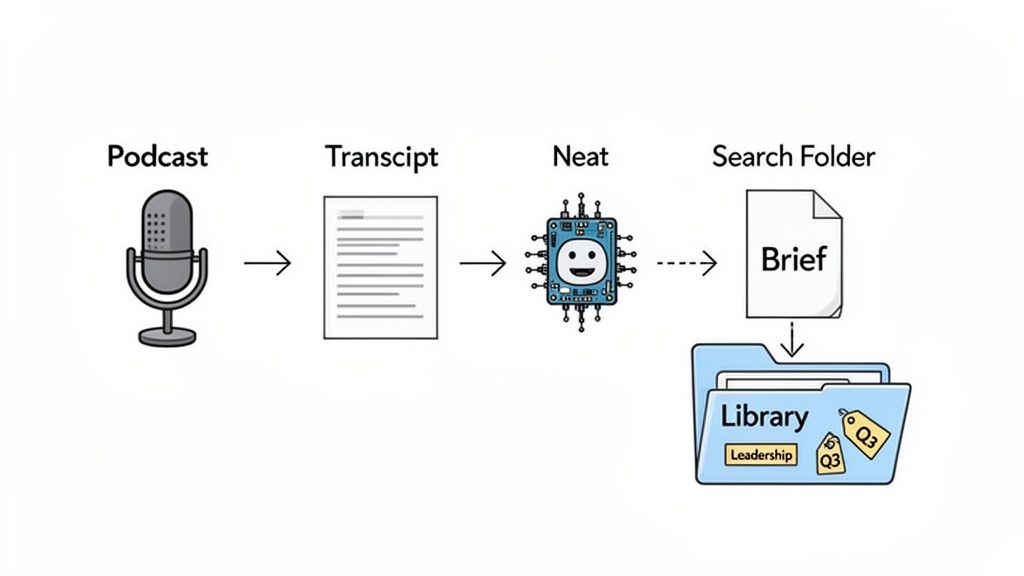
Manual summarization is an expense on your schedule. A fully automated approach turns that expense into an investment in your knowledge. Tools designed for this workflow can take over the entire process, from transcription to generating a structured executive brief.
Building Your Knowledge Base Automatically
The real game-changer isn't just the summary—it's what happens after. These systems automatically build a personal, searchable library of insights from every podcast you process. This strategy aligns with modern knowledge management best practices. You create a centralized intelligence asset that grows more valuable with every episode.
This is how you stop listening and start knowing. You turn information overload into a competitive advantage.
Your goal isn't to consume more podcasts. It's to extract more value in less time. Automation makes that possible at scale.
We built PodBrief to solve this exact problem. It puts the entire summarization workflow on autopilot, delivering actionable intelligence directly to you. It's about reclaiming your schedule and staying ahead of the curve.
Your Questions, Answered
Here are answers to common questions about summarizing long-form podcasts.
How Long Should a Podcast Summary Be?
The length depends on the purpose. For a personal reminder, a few bullet points suffice. For a leadership briefing, a polished one-page document is better.
My guideline is the 5-minute brief. Can someone grasp the summary in five minutes? This is typically 250-400 words, covering core ideas, key takeaways, and a few quotes without unnecessary detail.
Can AI Really Capture the Nuance of a Conversation?
Today's AI excels at extracting facts and themes. It's a massive time-saver. However, it can miss subtleties like sarcasm or unspoken tension.
For most professional needs, an AI-generated summary is reliable. For tasks requiring deep analysis of tone or sentiment, a quick human review is always a good idea.
What Is the Best Way to Store and Organize Summaries?
Build a centralized, searchable knowledge library. Tools like Notion or Evernote are perfect for this. The key is consistent tagging.
Tag each summary with relevant keywords. Think in categories like:
- Topic: "Leadership," "Q4 Marketing," "AI Integration"
- Podcast Show: "[Show Name]"
- Guest: "[Guest Name]"
This habit turns a collection of notes into a powerful intelligence database. It's the foundation of effective personal knowledge management.
Ready to stop summarizing and start knowing? PodBrief automates the entire process, turning any long-form podcast into a concise, actionable brief in minutes. Build your personal knowledge library effortlessly and stay ahead of the curve. Try PodBrief for free and get your first AI-powered summary today.


