
The Perfect Podcast Summary for Your Morning Commute

A podcast summary for your morning commute distills a long episode into a concise 5-to-10-minute brief. It’s an effective way to get core insights without the filler. This simple habit transforms traffic time into a competitive advantage, letting you absorb key information before your workday begins.
Turn Your Commute Into a Competitive Edge
The daily commute is a fixed block of time. It can be dead air or your secret weapon for getting ahead. Condensing long podcasts into tight, focused summaries is the best way for a busy professional to reclaim their time and stay informed.

When you think this way, your commute stops being a chore. It becomes a dedicated window for high-value learning. The goal is information density.
The Power of Information Density
A focused podcast summary delivers the core message of a 60-minute episode in less time than it takes to drink your morning coffee. This approach sets a powerful, informed tone for your day. You walk into the office armed with fresh ideas and the latest industry knowledge.
This isn't a niche habit; it's a growing trend. With global podcast listeners projected to hit 584.1 million by 2025, a huge portion of that listening happens during the drive to work. This is a golden opportunity. You can read more about the latest podcast listener trends to see the market's growth.
Maximize Your Morning Minutes
By adopting this strategy, you gain a serious edge. Instead of absorbing one long-form idea, you can cover key takeaways from several sources. That knowledge compounds weekly.
Here’s the bottom line:
- Reclaim Time: Save hours each week by skipping filler and getting straight to the point.
- Stay Sharp: Absorb critical insights daily from top experts in your field.
- Gain an Edge: Start your day with actionable intelligence your competition is likely missing.
This simple shift makes every minute of your commute count. Tools like PodBrief were built for this purpose, offering AI-powered briefs that streamline the process.
How to Select the Right Podcasts for Summarization
Not every podcast is a good candidate for a summary. The goal is to build a commute-sized queue of potent, relevant knowledge. You must be strategic about what you choose.
First, separate podcasts built for learning from those built for entertainment. A show like Acquired or Masters of Scale is packed with dense, actionable insights. Summarizing one is like getting concentrated value. Trying to summarize a narrative or comedy podcast misses the point—the value is in the journey, not just the bullet points.
Focus on Information Density
Your main filtering question should be about information density. Before summarizing an episode, ask: Does this conversation offer tangible takeaways, new mental models, or data-backed arguments? If the magic is in the host's chemistry, enjoy it in its full glory.
To build a "summary queue," use this mental checklist:
- Guest Credibility: Is the guest a legitimate expert with a unique viewpoint?
- Topic Relevance: Does this episode directly address a problem you face, a skill you're building, or a trend you need to follow?
- Actionable Potential: Can you pull 3-5 solid action items or key strategic points from this discussion?
The whole point is to make every podcast summary move the needle for you. This should be an active tool for professional growth, not a passive habit.
A Practical Framework for Selection
Categorize podcasts before they hit your summarization tool. Maintain a "Must Summarize" list for deep industry analysis and a "Listen in Full" list for interviews that are fascinating but less professionally critical. This simple model saves time and maintains focus.
Here’s a quick-reference table to help you decide.
Podcast Selection Framework for Summarization
| Podcast Type | Best for Summarization? | Key Reason Why |
|---|---|---|
| Interviews with Experts | Yes, excellent | Packed with specific insights, frameworks, and actionable advice from a credible source. |
| Deep-Dive Analysis | Yes, excellent | Dense with data, trends, and strategic thinking that can be distilled into key points. |
| Narrative/Storytelling | No, listen in full | The value is in the emotional arc and narrative journey, which a summary destroys. |
| Comedy/Banter Shows | No, listen in full | You can't summarize chemistry or humor; the timing and delivery are everything. |
| News & Current Events | Yes, good | Great for getting quick, high-level updates on daily topics without the filler. |
| Educational/How-To | Yes, excellent | Perfect for extracting step-by-step instructions or core concepts quickly. |
Choosing the right episodes is as important as the summary itself. When you pre-qualify content based on its potential to deliver high-impact knowledge, you ensure every minute of your commute is a direct investment in your goals.
Getting the AI to Give You What You Actually Want
The secret to a great AI-generated summary isn't the AI; it's the quality of your instructions. Vague requests yield vague summaries. To get a brief perfect for your commute, you must be direct and specific.
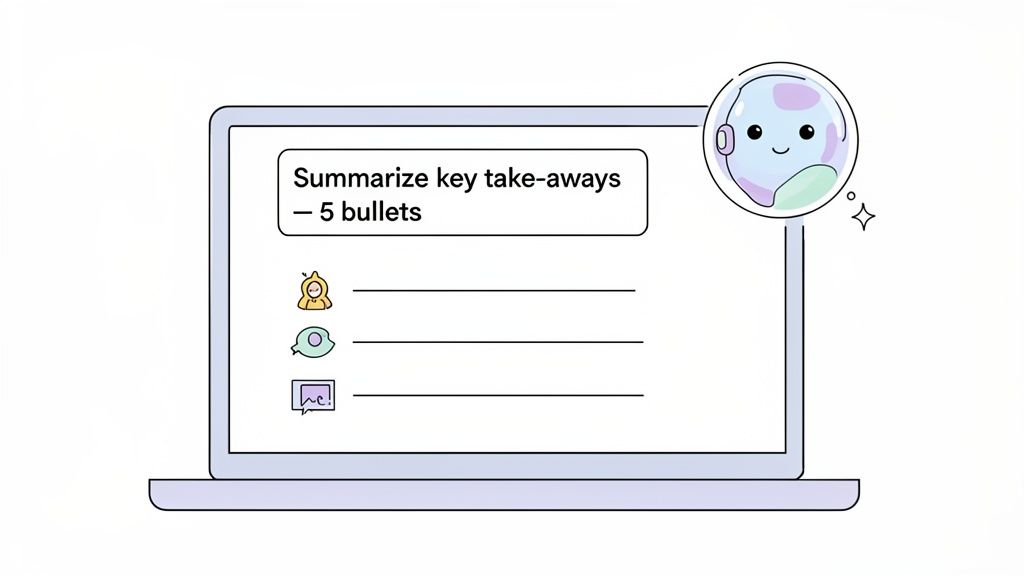
This is often called "prompt engineering." It’s simply about telling the AI exactly what you need. A solid prompt steers the AI toward the perfect output.
The Anatomy of a Killer Prompt
A good prompt needs to nail three things every time. Mastering these inputs will change the game, making your summaries more relevant and ready for your commute.
- Specify the Length: Be clear. Phrases like "in under 500 words" or "make this a 5-minute read" set firm boundaries. This ensures the summary fits your available time.
- Set the Tone: The tone dictates the summary's feel. Asking for an "executive summary style" delivers a formal, professional brief. Requesting "casual, conversational notes" produces a more relaxed recap.
- Demand a Format: Never leave formatting to chance. Use commands like "use bulleted key takeaways" or "list three actionable steps discussed." This makes the summary scannable.
Getting this right is critical. A YouGov study projects that by 2025, 41% of consumers will listen to at least one hour of podcasts weekly, with the commute being prime time. A well-structured brief is a necessity.
Sample Prompts for Different Podcasts
Your needs change with every episode. Adapt your prompts to match the content and your goals.
Template 1: For High-Level Strategic Insights
Use this when an episode covers big-picture ideas, market shifts, or future trends.
"Summarize this podcast in an executive summary format. Focus on the core strategic arguments, market analysis, and long-term predictions. Conclude with the top three takeaways for a business leader."
Template 2: For Actionable Steps
This is my go-to for episodes packed with practical advice or step-by-step instructions.
"Extract all actionable advice from this podcast. List each tactic as a bullet point with a one-sentence explanation of its purpose. The tone should be direct and instructional."
Template 3: For Understanding a Guest's Point of View
This prompt isolates an expert guest's perspective perfectly.
"Identify the guest's three primary arguments. For each, provide a short paragraph explaining their reasoning and supporting data. Focus exclusively on the guest's viewpoint."
Knowing how to write a good prompt is a superpower; it lets you transform a podcast transcript into an executive summary with just a few words.
However, manually crafting prompts for every episode is tedious. That's the problem platforms like PodBrief solve. It's already tuned to understand these nuances, delivering high-quality, structured briefs automatically.
Weaving Summaries Into Your Morning Routine
A perfect summary is useless if it sits on your device, unread. To get value from a podcast summary for your morning commute, you must make it a seamless part of your daily rhythm. The trick is to build a system that feels automatic.
Your goal is to make accessing your summary as reflexive as grabbing your keys. It shouldn't be another task. With a little planning, your daily insights will be ready the moment you step out the door.
Dialing in the Right Format for Your Trip
How you commute dictates how you should consume your summary. There is no single best way; find the path of least resistance for your situation.
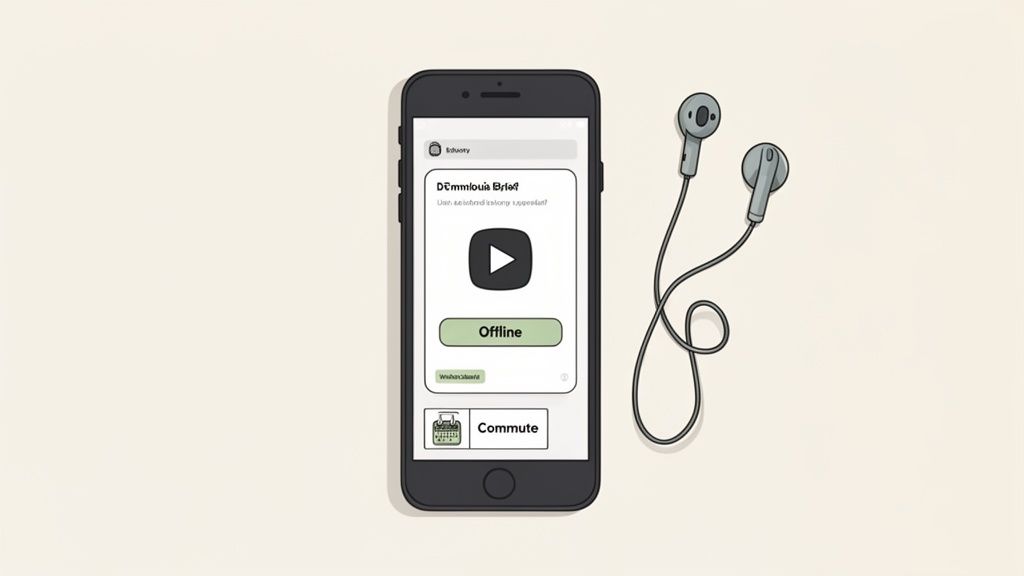
- Driving? Go Hands-Free: Audio is the only safe and practical choice. Use a text-to-speech (TTS) app or a service that generates an audio version of your summary.
- Public Transit? Text is Best: A written summary gives you total control. You can skim sections, reread statistics, or highlight takeaways. Download briefs beforehand to avoid service gaps.
- Walking or Biking? Use Audio: Like driving, an audio brief lets you absorb information while staying aware of your surroundings.
This one decision—text or audio—is the most important part of making this a lasting habit.
Curating Your Own Knowledge Library
The real magic happens long after your commute. Each brief is a nugget of concentrated knowledge. Archive it for later. Don't let these gems get lost.
Over time, your collection of summaries becomes a personal, searchable database of industry insights. Imagine prepping for a meeting and quickly pulling up relevant briefs to refresh your memory on key topics.
This requires a simple organization system. A dedicated folder in a cloud service or a tag in your notes app works well. Use a consistent naming convention like "[Podcast Name] - [Episode Topic] - [Date]." This discipline transforms random files into a powerful strategic resource.
A dedicated tool can make all the difference. PodBrief was built to handle these logistical headaches. It automatically generates both text and audio versions of every summary, so you always have the right format.
Better yet, all briefs are saved and organized in your personal library on the platform. It’s a unified system designed to turn a good idea into an effortless daily habit. You can even learn how to translate audio to text and back again to suit your day.
Mastering Multilingual Summaries for a Global Edge
Your next big idea might not be in English. In a connected world, critical insights are shared in podcasts from Berlin, Shanghai, or São Paulo. Language barriers keep that knowledge just out of reach.
This is a huge missed opportunity. Standard translation tools often fail, providing clunky, word-for-word conversions that miss the point. They cannot handle the nuance and context that make expert conversations valuable.
Beyond Basic Translation
You need AI that truly understands the conversation. Sophisticated models, trained on diverse data, don't just swap words; they grasp core arguments in the original language and articulate them clearly in another.
You could listen to the key takeaways from a German engineering deep-dive, perfectly summarized in English, on your way to work. This turns a podcast summary for your morning commute into a serious tool for international business.
How It Creates a Competitive Advantage
Accessing global insights before your competitors is a game-changer. It means you are the first to spot international trends, understand different market perspectives, and learn from a wider pool of experts.
Here’s the value:
- Access Untapped Knowledge: Tap into valuable podcasts in languages you don’t speak.
- Improve Global Collaboration: Share crucial findings with international teams in their own language.
- Spot Global Trends First: Identify emerging market shifts or tech breakthroughs from other regions.
When you break down language barriers, geography no longer limits your knowledge. Your daily commute becomes a window into global innovation.
This is the kind of problem services like PodBrief were built to solve. You can generate a clear, accurate brief of any podcast in the language you need with just a click. The AI does the heavy lifting: comprehending, translating, and summarizing.
For anyone working on a global scale, this is essential. You can learn more about the technology used to translate audio to text and other languages. Integrating multilingual summaries ensures your knowledge is as expansive as the markets you operate in.
Your Action Plan for a Smarter Commute
Theory is one thing; practice is another. It’s time to move from reading about a more efficient commute to experiencing it. This is your blueprint for creating the perfect podcast summary for your morning commute.
The plan is straightforward: first, curate your podcast queue for high-value content. Next, pick your format—audio for the car, text for the train. Finally, weave this new habit into your daily routine until it becomes automatic.
The Commuter's Checklist
This is not about adding another task. It's about swapping a low-value habit (like scrolling) with something that gives you a genuine edge.
Here’s a quick checklist to get started:
- Pinpoint Your Top 5 Shows: Identify podcasts that consistently deliver actionable, industry-specific insights.
- Set a Clear Goal: Know what you need—high-level strategy or tactical steps—before creating the summary.
- Block Out the Time: Dedicate the first 10 minutes of your commute to your summary. Make it non-negotiable.
- Build Your Library: Save every summary in a dedicated folder to build a powerful personal knowledge base.
Remember, language doesn't have to be a barrier. You can take insights from an English podcast and have them delivered as a Spanish text summary.

This process opens up a world of information.
The real takeaway is simple: save time, stay informed, and gain a professional advantage. Every minute invested in a focused brief pays you back in better decisions.
Now, stop planning and start doing. Put this to the test on your next commute.
Ready to make your commute count? Try PodBrief for free and get AI-briefings of your favorite podcasts. Experience the difference a focused, high-value summary makes.
A Few Common Questions, Answered
You have the basics, but a few questions often arise. Let's tackle them.
What’s the Sweet Spot for Summary Length?
Aim for five to ten minutes. That’s enough time to cover the core ideas of an hour-long episode without feeling rushed. The goal is information density, not just brevity.
Should I Read or Listen to My Summary?
This depends on how you get to work.
If you're driving, an audio summary is your only safe option. If you’re on a train or bus, a text version is fantastic. You can skim, re-read powerful quotes, and copy key takeaways. The best tools give you both options.
Does This Work for All Podcasts?
You can summarize anything, but you get the most value from information-heavy shows. Think business, technology, health, or science podcasts.
Narrative-style shows or comedy podcasts lose their magic in a summary. The experience is the story and delivery.
My rule of thumb: Summarize content where your goal is to extract actionable insights and new knowledge.
Ready to stop wasting time and start gaining a daily edge? PodBrief delivers concise, AI-powered summaries of your favorite podcasts. Stop listening to filler and start absorbing key insights in minutes. Try PodBrief for free and transform your next commute at podbrief.io.


