
How to Turn a Podcast Transcript Into an Executive Summary

Turning a podcast transcript into an executive summary saves time. It’s the fastest way to extract critical insights from a long conversation. This guide shows you how to distill a lengthy transcript into a tight, actionable document with key takeaways and strategic points.
Why Smart Leaders Summarize, Not Skim
Time is your most valuable asset. Reading a 10,000-word transcript is a poor use of it. Skimming might catch keywords, but you miss context, nuance, and the connection between big ideas. An executive summary is a strategic tool, not a quick recap.
This process turns raw dialogue into distilled intelligence. It filters signal from noise, leaving a clear, concise brief. You get core arguments, practical advice, and crucial data points without the conversational fluff. This workflow turns a mountain of words into pure knowledge.
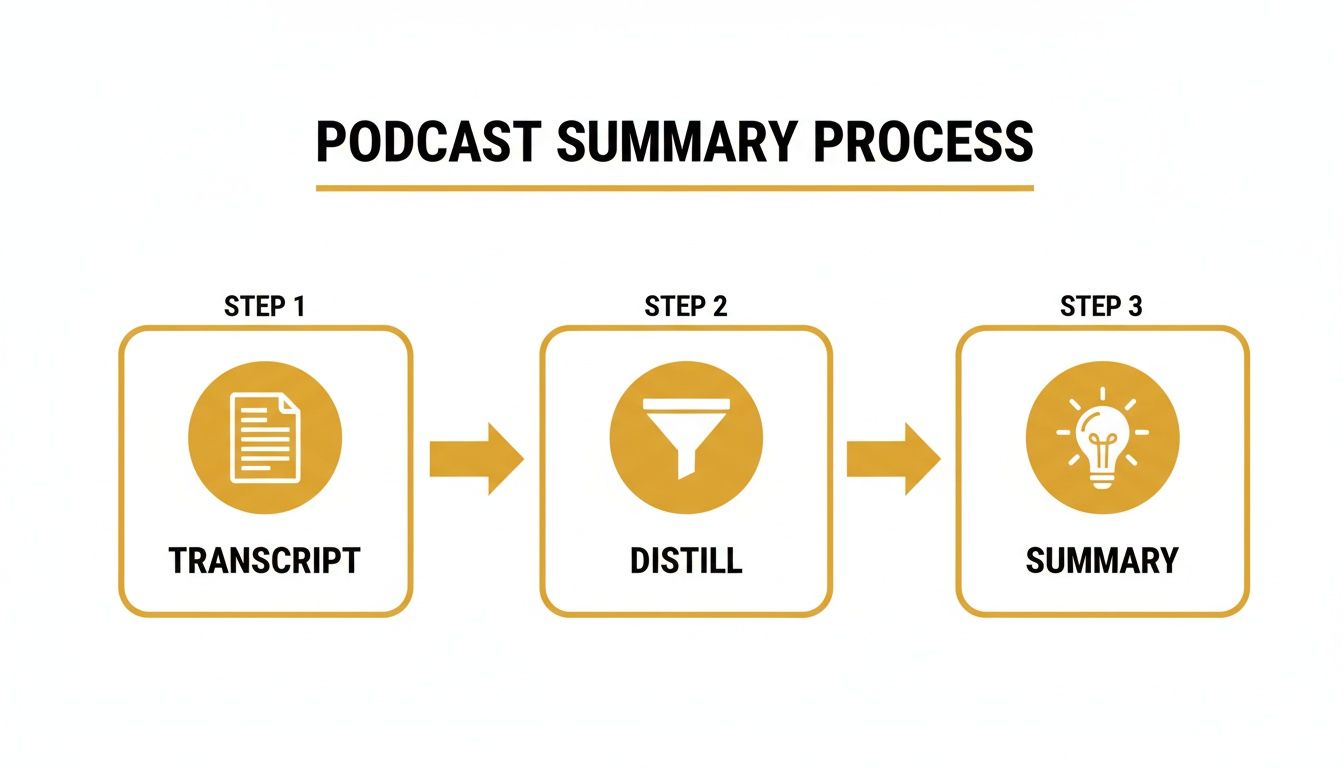
The key is the "Distill" step. That is where raw information becomes a strategic asset.
Combat Information Overload
Podcasts are a primary channel for deep industry insights. The explosive growth of the podcast market highlights its importance for staying competitive. But this flood of content creates a challenge: how do you keep up?
A well-crafted executive summary is the solution. It helps you:
- Absorb key insights in minutes, not hours.
- Pinpoint actionable takeaways instantly.
- Attribute ideas to the correct speaker for clear context.
- Share critical information with your team efficiently.
Transcript vs. Executive Summary: A Quick Comparison
A transcript is not "good enough" for a busy professional. One is a raw data dump; the other is a refined intelligence brief. The difference in value is significant.
| Attribute | Raw Transcript | Executive Summary |
|---|---|---|
| Length | Extremely long (10,000+ words) | Very short (400-600 words) |
| Time to Read | 45-60 minutes | 3-5 minutes |
| Focus | Verbatim dialogue, including filler | Key themes, action items, conclusions |
| Clarity | Low; signal mixed with noise | High; distilled for strategic value |
| Usability | Difficult to scan or share | Designed for quick decisions and sharing |
| Purpose | Legal record, detailed analysis | Rapid insight, executive briefing |
The executive summary is built for action. The transcript is built for record-keeping. They serve fundamentally different purposes. Converting a podcast transcript to an executive summary is a massive productivity multiplier. It respects your time by delivering maximum value for minimum effort. Tools like PodBrief automate this entire process, turning hours of audio into five-minute briefs you can read or listen to.
Prepare Your Transcript for a Flawless Summary
A great summary requires a clean transcript. A messy, raw transcript is a minefield of errors. It will confuse AI tools and human readers, leading to inaccurate or useless summaries.
This isn’t just about fixing typos. It's about structuring rambling dialogue into clean, logical text ready for analysis. The old saying holds true: garbage in, garbage out.
Start with Accurate Transcription
The quality of your summary depends on the accuracy of the initial transcription. Automated services are fast but can struggle with multiple speakers, technical jargon, or accents. Investing in accurate transcription is the most critical first step.
When you translate audio to text, a single error can flip the meaning of a key insight. A speaker might say "increase our deck by 10%," but the transcript reads "increase our debt by 10%." These are two very different strategies.
Bottom-Line: Do not compromise on transcription quality. A few extra minutes or dollars upfront will prevent major errors later.
Essential Transcript Cleanup Checklist
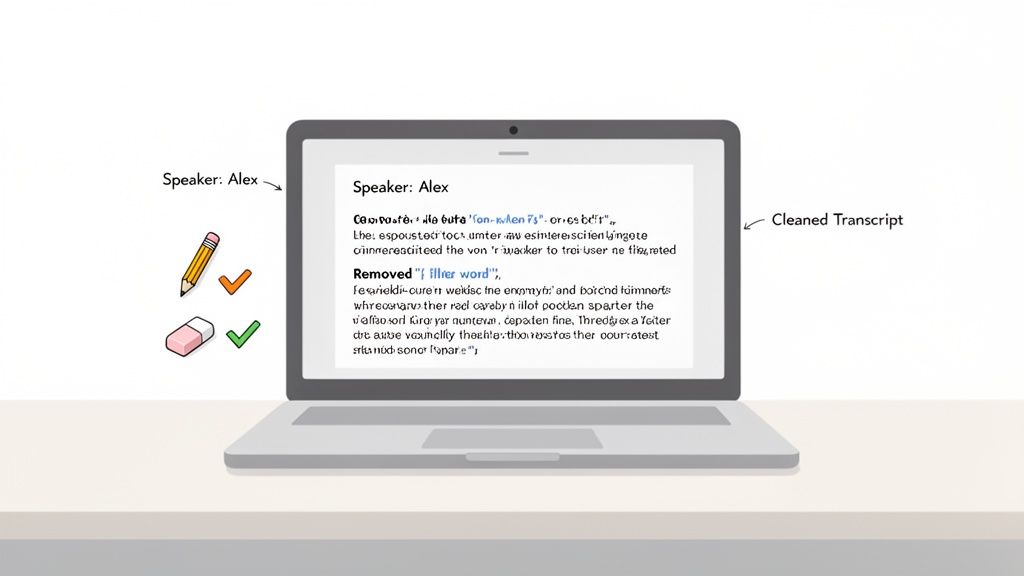
With a transcript in hand, perform a quick cleanup. The goal is to remove conversational "noise" so the core ideas stand out. Focus on these key areas.
- Correct Speaker Labels: Ensure every speaker is identified correctly and consistently. Use actual names, not "Speaker 1." This is non-negotiable for attributing insights correctly.
- Remove Filler Words: Delete all "ums," "ahs," "you knows," and "likes." They add zero value and clutter the text.
- Scrub Timestamps and Repetitions: Remove timestamps (e.g., [00:15:32]) and any stuttered words or false starts.
- Clarify Ambiguities: Break up run-on sentences. Rephrase unclear statements. Separate overlapping speakers into coherent thoughts.
This manual polish is what separates a mediocre summary from a professional one. Of course, this is exactly the work AI excels at. A platform like PodBrief automates both transcription and cleanup, giving you a pristine foundation for your summary without the manual effort.
Find the Gold: Pinpoint Core Themes and Actionable Insights
With a clean transcript, you shift from editor to analyst. The goal is now strategic value. You must find the core arguments, recurring ideas, and actionable insights that make the podcast transcript to executive summary conversion worthwhile.
This step separates a simple recap from a true executive brief. A recap tells you what was said. An analysis tells you what matters. You must find the "so what?" behind the conversation.
Zero In on Main Arguments
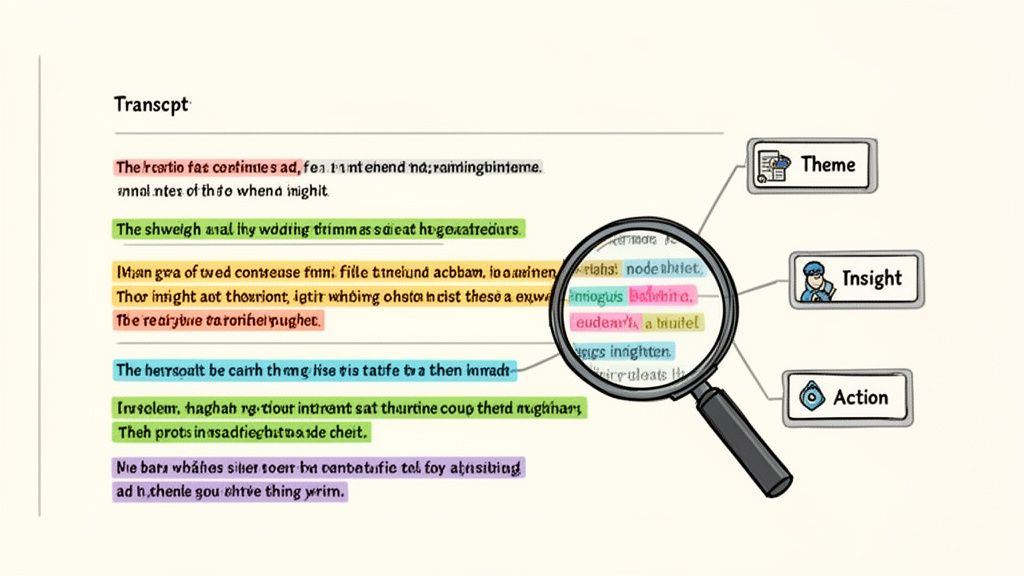
Every good podcast has a central thesis or a few key arguments. Your first mission is to spot them. Read through the transcript, looking for patterns, repeated phrases, or definitive statements.
If doing this manually, you would highlight sentences that feel like main pillars of the discussion. An AI assistant gets you to the heart of the matter much faster.
Pro Tip: Look beyond words to context. A speaker’s background or company adds crucial meaning to their statements and helps you interpret their message correctly.
From Manual Highlighting to AI-Powered Analysis
The manual approach works but is slow. AI tools can dramatically speed up this process by identifying thematic clusters and analyzing sentiment. Instead of highlighting text, use specific prompts to guide a deeper analysis.
This efficiency is critical. Global podcast listenership is projected to hit 584 million people in 2025, per global podcast listener statistics. This audience includes C-suite executives and professionals hunting for valuable information.
Here are a few powerful prompts to use with an AI assistant:
"Analyze the attached transcript and identify the top 3-5 core themes discussed. Present them as bullet points.""Extract all actionable advice or recommendations mentioned. List each one with the speaker who proposed it.""What are the main arguments and counterarguments presented? Summarize the key points for each side.""Identify any statistics, data points, or case studies mentioned and list them."
Think Like an Analyst, Not a Transcriber
Uncovering real insights requires an analytical mindset. You are searching for intellectual gold: a new strategy, a surprising statistic, a contrarian viewpoint, or a practical solution.
The human touch remains critical here. While AI is great at finding patterns, your professional judgment decides which patterns matter. PodBrief is an AI-powered tool built to do this heavy lifting, automatically flagging key themes and takeaways. This allows you to focus on applying insights, not just finding them.
Structure a High-Impact Executive Summary
You have the key insights. Now you must arrange them to be read and used. Structure is everything. A well-structured executive summary is a practical tool designed for scanning and comprehension in minutes.
The right framework transforms a rambling conversation into a strategic asset. It makes information accessible and actionable, informing real decisions.
The Anatomy of a Perfect Summary
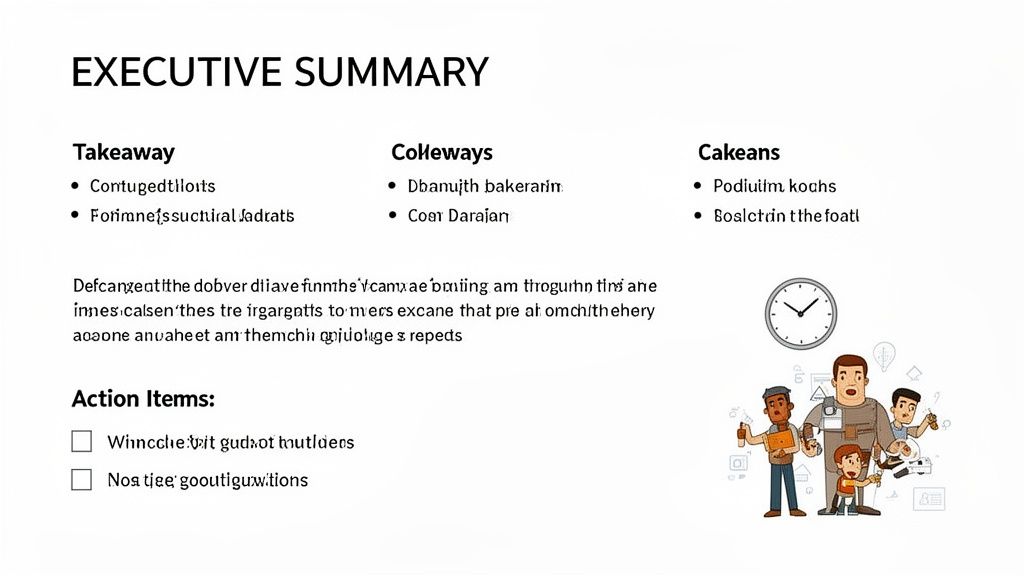
The best summaries follow a simple, logical flow. Each section builds on the last, taking the reader from a high-level view to practical details. There is no fluff.
This structure delivers maximum impact in minimum time. When turning a podcast transcript into an executive summary, this is the ideal framework:
- The One-Sentence TL;DR: Start with a single sentence that captures the core thesis of the conversation. This "bottom line" tells a busy reader if the summary is worth their time.
- Key Takeaways (3-5 Bullets): Break out the most important insights into bullet points. Each should be a complete thought highlighting a major theme, statistic, or argument.
- Thematic Overview (Short Paragraph): Follow up with a concise 2-3 sentence paragraph to add context. Connect the takeaways and paint a quick picture of the conversation's narrative.
- Actionable Items (Bulleted List): Finish with a clear list of next steps or recommendations. This turns the summary from a passive document into an active tool.
Before and After: The Transformation
Let's make this concrete. Imagine a speaker discussing market entry strategies with typical conversational filler.
Before (Raw Transcript Snippet):
"So, you know, we were thinking, like, maybe the best way to get into the European market is... well, there are a few options. I mean, direct sales is one, but that's, uh, super capital-intensive. Another way, which I think is probably smarter for us right now, is finding a key distribution partner. Someone who already has the network... it just reduces risk, you know?"
After (Polished Summary Point):
- Prioritize a distribution partnership over direct sales for European market entry to minimize capital risk and leverage existing networks.
The difference is clear. We've removed the noise to deliver a direct, strategic takeaway. That is the goal.
Don't Forget the Audio Brief
A written summary is perfect for scanning, but many people absorb information better by listening. Creating a 5-minute audio brief is a game-changer. It caters to different learning styles and busy schedules, perfect for a commute.
This is where a tool like PodBrief shines. It automates this entire workflow, generating a structured text summary and a clean audio brief from any podcast. You get a finished intelligence packet delivered in minutes, saving you hours of manual work.
Dig Deeper with Advanced AI Prompts
A basic summary is good. A targeted analysis is better. Using specific AI prompts turns the podcast transcript to executive summary process into a true intelligence-gathering exercise. You move from "what was said" to "what does this mean for me?"
Think of it like briefing an analyst. "Summarize this" gets a generic overview. A precise mission gets actionable insights. This is the power of AI: extracting specific, strategic information that can shape your next business decision or client meeting.
Prompts for Strategic Analysis
Better outputs require better inputs. Be crystal clear about what you need. Are you hunting for competitive intel, market trends, or potential risks? Each goal requires a different prompt.
You must guide the AI to look through a specific lens. The more detailed your instructions, the more relevant the summary will be.
Here are go-to prompts for generating high-quality summaries from a transcript. Tweak them to fit your specific needs.
Sample AI Prompts for High-Quality Summaries
| Goal | Sample Prompt |
|---|---|
| Find Counterarguments | "Analyze this transcript and extract the primary argument. Then, identify and list all counterarguments or opposing viewpoints mentioned. Attribute each point to the correct speaker." |
| Pinpoint Actionable Advice | "Scan the text for all instances of actionable advice or recommendations. Present them as a numbered list, starting each with a strong action verb (e.g., 'Implement,' 'Investigate')." |
| Extract Hard Data | "Extract all statistics, data points, and financial figures mentioned. List them in a table with columns for 'Metric' and 'Value/Context'." |
| Generate Follow-Up Questions | "Based on the key themes in this transcript, generate five insightful follow-up questions I could ask in a meeting on this topic." |
| Identify Industry Trends | "Identify and list all emerging industry trends or new technologies discussed. For each, provide a brief quote from the speaker who mentioned it." |
| Analyze Speaker Sentiment | "Analyze the sentiment of the main speakers. Are they optimistic, cautious, or critical about the main topics? Provide examples to support your analysis." |
These prompts push AI beyond simple summarization. They force a genuine analysis, giving you a much richer final product.
Unlock Multilingual Summaries
For global teams, sharing insights across language barriers is a huge advantage. Prompting an AI to translate and summarize in one step is highly efficient. This turns a single podcast into a shared resource for an international team. Learn more about the features of a truly effective AI podcast summarizer.
Example Prompt for a Multilingual Brief:
"Read the attached English transcript. Create a concise executive summary in Spanish that includes the top three key takeaways and a list of actionable items. The tone must be professional for a leadership team."
Specialized platforms excel where general AI tools stumble. Tools like PodBrief handle complex requests like seamless multilingual outputs. Instead of wrestling with prompts, you get a perfect, ready-to-use summary in the language you need, every time.
Build Your Personal Insight Library
A single summary is useful. A searchable library of summaries is a strategic asset.
Over time, these briefs connect and compound. They build a powerful knowledge base for meeting prep, strategic planning, or sparking new ideas. This shifts you from passive listening to active knowledge capture. Great insights are cataloged and ready when you need them, building a real competitive edge.
Choose Your Storage System
Your storage system matters. It must be simple enough for consistent use but powerful enough for tagging and searching. Do not overcomplicate it.
Here are a few popular options:
- Simple Note-Taking Apps: Tools like Apple Notes or Google Keep are perfect for getting started. They are easy to use and sync across devices.
- Advanced Knowledge Hubs: For more structure, platforms like Notion, Evernote, or Obsidian are excellent. They allow sophisticated tagging and linking, creating a custom database of insights.
The best tool is one that fits your existing workflow. For more on setting up a system, review these knowledge management best practices.
A Simple Tagging Framework
An untagged library is a digital junk drawer. To make summaries useful, you need a simple, consistent tagging framework. Starting with three core categories is the sweet spot.
Bottom-Line: A consistent tagging system is what makes your library work. It saves you from scrolling and searching. Start with a simple framework and stick to it.
Try this simple structure for every summary you save:
#topic: The main subject (e.g.,#marketing,#AI,#leadership).#person: Key speakers or people mentioned (e.g.,#ElonMusk,#BreneBrown).#company: Companies discussed (e.g.,#Nvidia,#OpenAI).
This basic system is highly effective. It lets you instantly pull up every insight related to a specific topic, person, or organization.
Building and maintaining this library takes time. That’s why PodBrief was designed to automatically create this searchable library for you. Every summary is stored, tagged, and ready to go, solving the problem right out of the box.
Frequently Asked Questions
Here are quick answers to common questions about turning podcast transcripts into executive summaries. I'll cover ideal length, AI reliability, and handling multiple speakers.
What's the ideal length for an executive summary?
For an hour-long podcast, a summary that takes 3-5 minutes to read is ideal. This is typically 400-600 words. The goal is to grasp core concepts quickly. A good structure is a single punchy sentence stating the main idea, followed by 3-5 bullet points with key takeaways, and a brief paragraph on overarching themes.
Can I trust AI to capture nuance?
Today’s AI is excellent at extracting facts, identifying themes, and summarizing arguments. It is a massive time-saver. However, it can miss subtle humor, sarcasm, or deep industry jargon. I recommend a quick human review as the final step. That last 5% of polish makes all the difference.
How do I handle multiple speakers in a summary?
First, ensure your transcript has accurate speaker labels. This is non-negotiable. When writing the summary, attribute key points to the correct person (e.g., "Dr. Smith argued that..."). This is crucial for maintaining context, especially in debates where guests have conflicting views. You must know who said what.
Stop wrestling with manual summaries. PodBrief handles the entire process, turning any podcast into a clear, actionable brief in minutes. Try PodBrief for free today and get an AI-briefing of the topics discussed in this article.


