
The Executive's Guide to a Summary of a Podcast

Drowning in "must-listen" podcasts? A summary of a podcast is your lifeline. It’s a tight, focused brief of a full episode, giving you the core message in minutes.
For busy professionals, this isn't a shortcut. It's a strategic edge. It turns passive entertainment into a powerful professional development tool. Get the insights you need, faster.
What Is a Podcast Summary and Why You Should Care

Podcasts are a major source of expert insights and industry news. With millions of episodes, the challenge is information overload. You don’t have time to listen to every relevant discussion.
This is where a summary of a podcast delivers value. It’s an executive briefing for audio. You get the critical intelligence without sitting through the hour-long presentation. It delivers the signal, not the noise.
This strategy helps you act on crucial information faster than your competition. By absorbing distilled insights, you stay ahead of trends and make sharper decisions. It's about maximizing your return on time.
The Problem of Scale
The podcasting universe is massive and expanding. The global audience is set to hit 584.1 million listeners in 2025. In the U.S., 55% of Americans aged 12 and older listen monthly. The challenge is no longer finding listeners; it's helping them consume content efficiently. You can discover more podcast growth statistics to see the scale of this information boom.
Key Benefits of Podcast Summaries
The advantages for a time-crunched leader are clear and immediate. A well-crafted brief helps you:
- Absorb Key Information Faster: Condense a 60-minute interview into a five-minute read.
- Make Better Decisions: Quickly gather expert opinions on a topic before making a call.
- Stay Ahead of Industry Trends: Monitor competitor interviews and market analysis without dedicating hours.
- Improve Team Knowledge: Easily share actionable advice from leadership podcasts with your team.
Ultimately, using a summary of a podcast isn't about listening less. It’s about learning more. It is a smart system for turning audio into a strategic asset that respects your most valuable resource: your time.
The True Cost of Manual Podcast Summarization
Creating your own podcast summary seems productive, but it's a deeply inefficient process. The hidden costs drain your time, focus, and money.
The most obvious cost is time. A one-hour podcast takes an hour to hear. The real work comes after. You will spend another one to two hours re-listening, typing notes, and shaping them into a coherent summary. That’s a two-to-three-hour commitment for a single episode.
Think about what you could do with that time. That is time you could spend closing a deal, mentoring a team member, or building a strategy. Every hour spent on manual note-taking is an hour not spent on high-impact work.
The Hidden Drain on Your Focus
Manual summarization puts a huge strain on your brain. You are constantly switching from listening, to analyzing, to typing. This multitasking shatters your focus and makes it harder to absorb information deeply.
It’s also easy to make mistakes or let biases creep in. You might miss a crucial detail while typing or give more weight to a point that confirms what you already believe. An effective summary of a podcast must be objective, but our brains are wired for subjectivity.
A manual summary reflects what the listener thought was important, not the speaker's core message. This introduces interpretation that can distort the original insight.
Quantifying the Financial Impact
At scale, the financial cost is staggering. Three hours of a manager's time is worth several hundred dollars. As a weekly habit, the cost spirals into thousands annually—all for a task that can be automated.
This old-school approach doesn’t scale. What if you need to translate audio to text for a podcast in another language? The time and expense explode. You need specialized skills or expensive services, adding more friction to a broken process.
The DIY method is a holdover from a pre-automation world. Tools like PodBrief handle the heavy lifting. Instead of burning hours, you get a structured, objective summary in minutes. The business case is clear: stop trading leadership time for a low-value administrative task.
How AI Delivers a Smarter Podcast Summary
AI for audio goes far beyond simple transcription. Modern AI doesn't just hear audio; it understands it.
Using Natural Language Processing (NLP), these tools analyze speech, identify speakers, and detect sentiment. This is how AI gets to the heart of the discussion. It is trained to find the episode's core arguments, key facts, and critical data points.
Simultaneously, it weeds out conversational filler and repeated points. You get a clean, structured brief with actionable insights and zero noise.
Beyond Transcription to True Understanding
Summarizing a podcast yourself is a linear, time-consuming process.
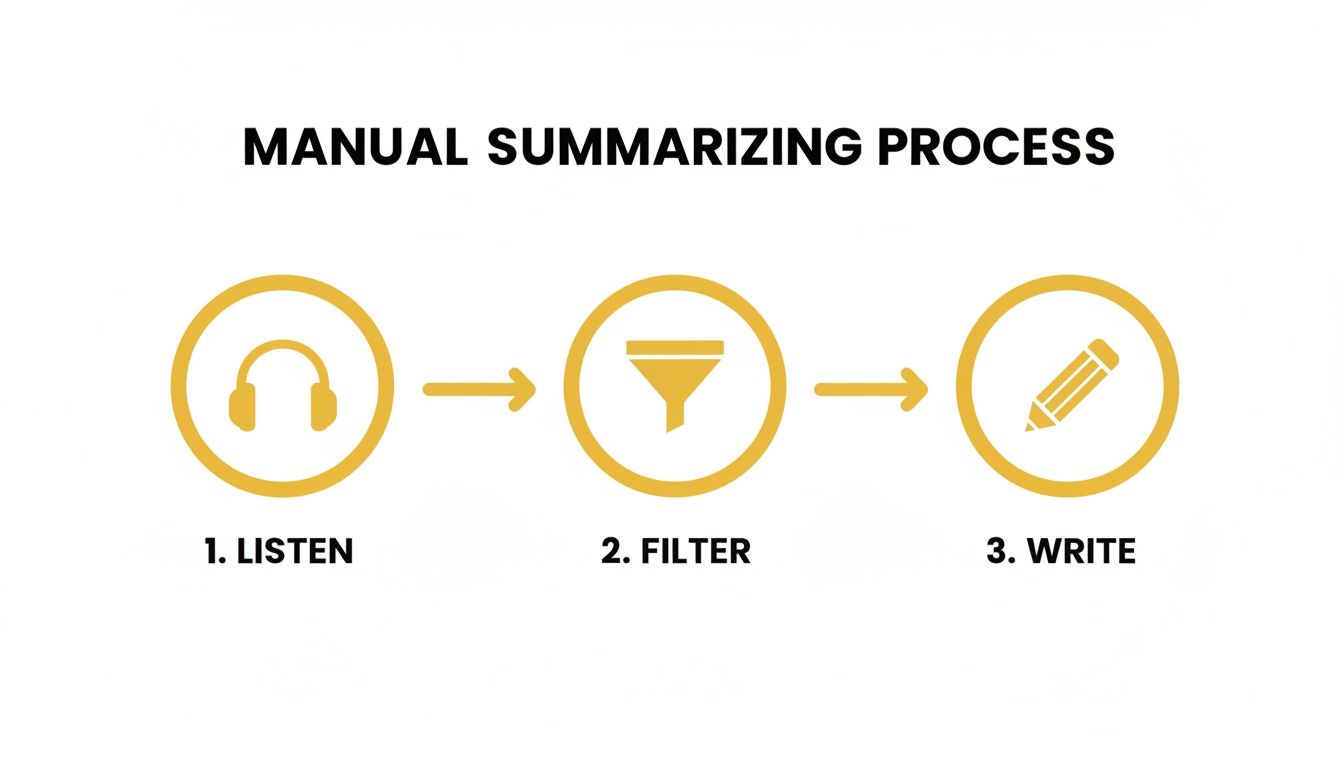
You must listen intently, filter unimportant details, and write coherently. AI automates this workflow, doing in minutes what takes a person an hour or more, often with better accuracy.
The result is a smarter, more reliable summary of a podcast. A good AI podcast summarizer delivers an organized output. It includes clear headings, bullet points, and speaker labels, making the information easy to scan and digest.
Tapping into a Global Knowledge Base
The global podcast market is on track to hit $131.13 billion by 2030. This boom creates a massive language barrier for manual methods. For AI, it’s not a problem.
Tools like PodBrief have multilingual support. You can take a podcast from another country and get a detailed summary in your own language.
This unlocks a world of insights. You can absorb lessons from a tech founder in Germany or a market analyst in Japan without speaking their language. It is nearly impossible to do this manually at scale.
This is not just a convenience; it's a competitive edge. AI lets you tap into a global reservoir of expertise. You can stay on top of international trends and find intelligence your competitors are not even looking for.
Actionable Use Cases for Busy Professionals
A podcast summary is a workhorse in your professional toolkit. These briefs are a source of competitive intelligence, a launchpad for ideas, and an effective training resource. They help you shift from passive listening to active knowledge gathering.
The real value is in speed and precision. Imagine walking into a meeting fully briefed on the latest industry analysis, which you "read" in the five minutes it took to get to the conference room. This is the new baseline for being prepared.
Competitive Intelligence and Market Research
When a competitor's executive appears on a podcast, they offer free strategic insights. An automated summary of a podcast creates a streamlined intelligence workflow.
- Monitor Competitor Strategy: Get a quick brief on competitor interviews. Instantly see their talking points on new products, market position, and future plans.
- Track Industry Trends: Follow key thought leaders and analysts. Absorb their latest thinking on market shifts in minutes.
- Identify M&A Signals: Executives often drop subtle hints about acquisitions. A detailed summary can flag these nuances for a heads-up on market movements.
This approach transforms podcasts from media into a live stream of valuable market data.
Content Marketing and Idea Generation
A good content strategy requires a constant flow of fresh ideas. Podcast summaries are a goldmine for this. They help you quickly see which topics resonate with your audience and what experts are discussing now.
By summarizing expert interviews, you create a high-level outline of the most important topics in your industry. This is a shortcut to creating timely and relevant content.
Use these briefs to pull compelling statistics or unique arguments. This makes it easier to generate blog posts and social media updates grounded in expert opinion. A single summary can provide enough material for a week's worth of content.
Team Development and Training
Helping your team grow is a leader's priority. Podcasts are packed with lessons on management, sales, and technical skills. Assigning an hour-long episode as "homework" is unrealistic.
A summary of a podcast is the perfect solution. Share distilled wisdom from top leadership gurus in a format your team can actually digest.
- Share Actionable Insights: Send a summary on sales tactics to your team before a weekly meeting.
- Distribute Leadership Lessons: Find a great interview on company culture? Share the summary with your management team to spark discussion.
- Onboard New Hires: Create a curated playlist of industry-specific summaries to help new employees get up to speed fast.
With PodBrief, this is simple. It transforms podcast content into scalable training material, turning insight into action for your whole organization.
Building Your Personal Knowledge System
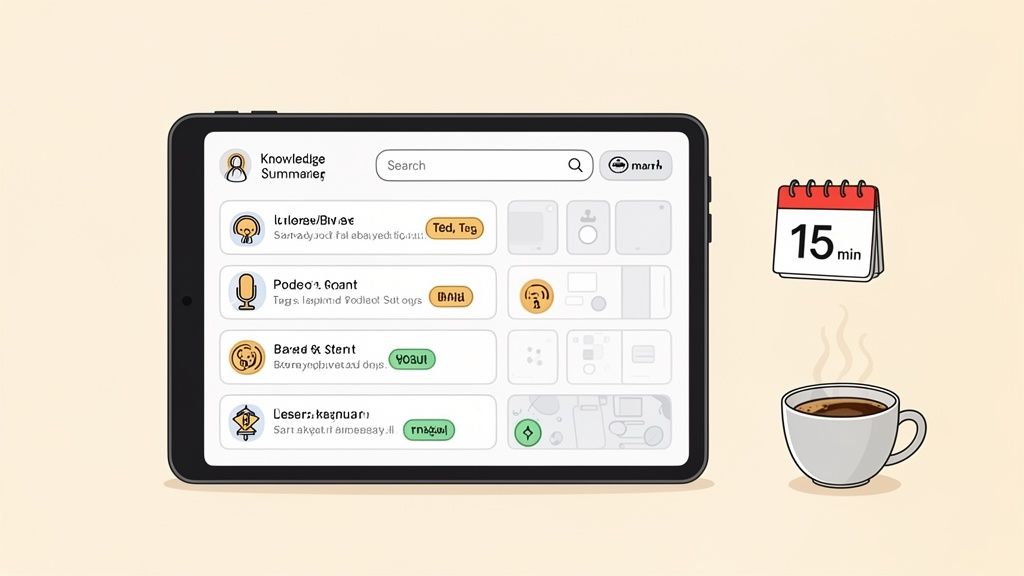
A summary of a podcast is the first step in a system for continuous learning. The goal is to build a workflow that turns scattered insights into an organized, searchable knowledge base.
Imagine a new morning routine. Instead of checking email, spend 15 minutes reviewing summaries of the latest industry podcasts. It becomes your personal executive briefing, arming you with key takeaways before your first meeting.
This simple habit builds momentum. You actively capture valuable ideas that would otherwise be lost. You build a powerful intellectual asset you can draw from anytime.
Creating a Searchable Knowledge Library
The real value comes from turning summaries into a personal library. Each brief becomes an entry in your knowledge base. With the right tool, these summaries are automatically saved, tagged, and searchable.
This enables "just-in-time learning." Have an unexpected client call in ten minutes? Quickly search your library for a relevant topic and pull up an expert's key points.
This on-demand access to distilled expertise is a significant competitive advantage. It allows you to enter any conversation with fresh, relevant insights at a moment's notice.
An organized library means no insight is wasted. It becomes your external brain, ready to feed you the right information when you need it. To learn more, read our guide to knowledge management best practices.
The Essential Role of a Dedicated Tool
Building this system manually is frustrating. Juggling notes, organizing links, and tagging topics is a waste of time. A dedicated tool makes this workflow practical.
A platform like PodBrief is built for this purpose. It handles the entire process:
- Generation: Instantly creates a clean summary of a podcast for any episode.
- Organization: Automatically saves every brief into a personal, centralized library.
- Retrieval: Lets you use powerful search to find specific insights by keyword or topic.
By removing the manual labor, you can focus on absorbing and applying knowledge. This is how you shift podcast listening from a passive hobby into a strategic tool for professional growth.
Putting AI Podcast Summaries to Work for You
Knowing summaries are valuable is one thing; putting them to work is another. Hunting for pre-written briefs online is unreliable and defeats the purpose of saving time.
The most practical approach is a tool that generates a sharp, accurate summary of a podcast for any episode, on demand. This puts you in control of your information diet. You decide what's worth learning, and the right tech delivers those insights.
From Passive Habit to Strategic Advantage
This is where a service like PodBrief comes in. It is designed to shift your podcast habit from passive to active. Instead of dedicating hours to listening, you spend minutes absorbing core ideas.
Consider the workflow:
- Stop Wasting Hours: No more slogging through an episode for one or two key insights.
- Gain Insights in Minutes: Quickly pull the main arguments, data points, and actionable advice.
- Build a Smarter Workflow: Seamlessly weave distilled knowledge into your daily routine.
The goal is to stop being a passive consumer of information and become an active architect of your knowledge. This is how you gain a real edge.
Stop letting valuable time disappear. Try PodBrief for free and get your first AI-powered podcast briefing today. Start turning long-form audio into actionable intelligence.
Got Questions? We’ve Got Answers.
Here are answers to the most common questions we hear about AI podcast summaries.
How Accurate Are AI Podcast Summaries?
They are highly accurate. Modern AI uses sophisticated language models to find the core message. They pinpoint main arguments, extract takeaways, and flag important data.
They are smart enough to cut out chatter and fluff, but they are designed to preserve the original context and intent. You get a brief you can trust.
What Kinds of Podcasts Work Best for Summaries?
Summaries are ideal for information-dense podcasts. This includes expert interviews, business news, industry analysis, and educational shows.
If your goal is to learn and extract actionable information efficiently, a summary is perfect. For comedy or storytelling, you will likely prefer the full episode.
Can I Get a Summary for Any Podcast Episode?
Yes, for virtually any publicly available episode. Instead of waiting for others to write notes, you take control. Just provide the episode link to a service like PodBrief and get a custom brief.
How Long Does a Summary Take?
Not long. For a typical hour-long podcast, a good AI tool generates a full summary in just a few minutes. This speed is what makes the process practical.
Are the Summaries Biased?
One of the biggest advantages of AI is objectivity. A human summary can reflect the writer's personal interests. They may focus on what they found interesting, not what was most important.
In contrast, AI focuses solely on the episode’s primary arguments and data. It doesn't have an opinion. The result is a neutral, accurate reflection of what was said.
Stop scrolling through hour-long episodes. Start getting key insights in minutes. PodBrief delivers the AI briefings you need to stay ahead.
Try PodBrief for free today and see how much time you can save.


