
A Complete Guide to Creating a Transcript for Podcast Episodes

A podcast transcript is a word-for-word text version of your audio episode. For a professional, it is a strategic asset. It converts spoken words into a searchable, scannable, and shareable format for growth.
Transcripts unlock the value trapped inside your audio files. This guide shows you how to use them effectively.
What Is a Podcast Transcript and Why It Matters
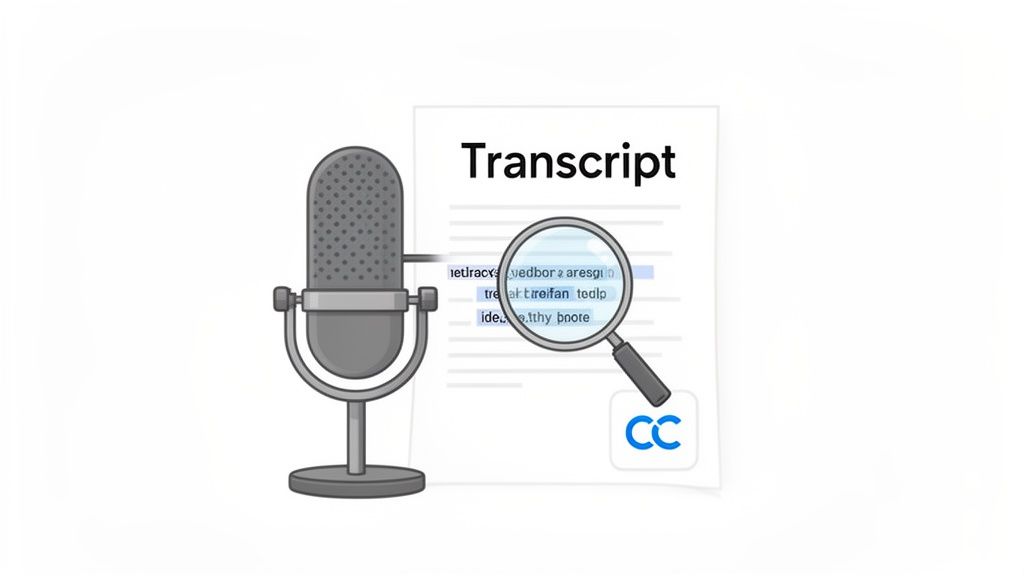
A transcript for a podcast transforms your content from a listening experience into an engine for discovery. It converts your episode into a text format that people and search engine crawlers can read. This single action expands your podcast's reach.
Your raw audio file is like a locked room of insights. A transcript is the key. It allows search engines like Google to index every word. Your episode then appears in search results for the topics you discussed. This is the foundation of long-term organic discoverability.
The Strategic Value of Text
The podcasting industry is growing, with revenue expected to reach $131.13 billion by 2030. Getting noticed is critical. Professionals use transcription to make their content visible, attract sponsors, and drive business. You can get more insights on the latest podcast statistics to understand the competitive landscape.
A transcript makes your audio searchable. It turns spoken words into a permanent, indexable asset that works for you long after an episode is published.
Beyond search results, transcripts improve your workflow and performance. They are not an optional feature. They are a fundamental part of a smart content strategy.
Core Benefits of Podcast Transcription at a Glance
This table breaks down the main advantages and their real-world impact.
| Benefit | Impact on Your Podcast | Key Takeaway |
|---|---|---|
| SEO & Discoverability | Google indexes your episode's content, helping you rank for relevant keywords. | More text means more chances for new listeners to find you via search. |
| Accessibility | Opens your content to the deaf, hard-of-hearing, and non-native speakers. | A larger, more inclusive audience can engage with your work. |
| Content Repurposing | Provides a ready-made source for blog posts, social media, and newsletters. | Maximize your effort by turning one episode into multiple pieces of content. |
Each benefit helps you build a stronger, more visible brand.
Boosts SEO and Discoverability
This is the biggest benefit. Search engines cannot "listen" to audio files. They are experts at reading and indexing text. A full transcript provides a goldmine of keywords, improving your chances of appearing in search results.
Enhances Accessibility
A transcript makes your podcast accessible to a wider audience. This includes people who are deaf or hard of hearing. It also helps non-native speakers who find it easier to read along. It serves listeners in noisy environments who can read but not listen.
Simplifies Content Repurposing
Do not let a great episode live only as an audio file. A transcript is the ultimate source material for content repurposing. You can pull quotes for social media, turn a segment into a blog post, or compile highlights for a newsletter. This allows you to maximize your content ROI without recording new material.
Unlocking Growth with Podcast Transcripts
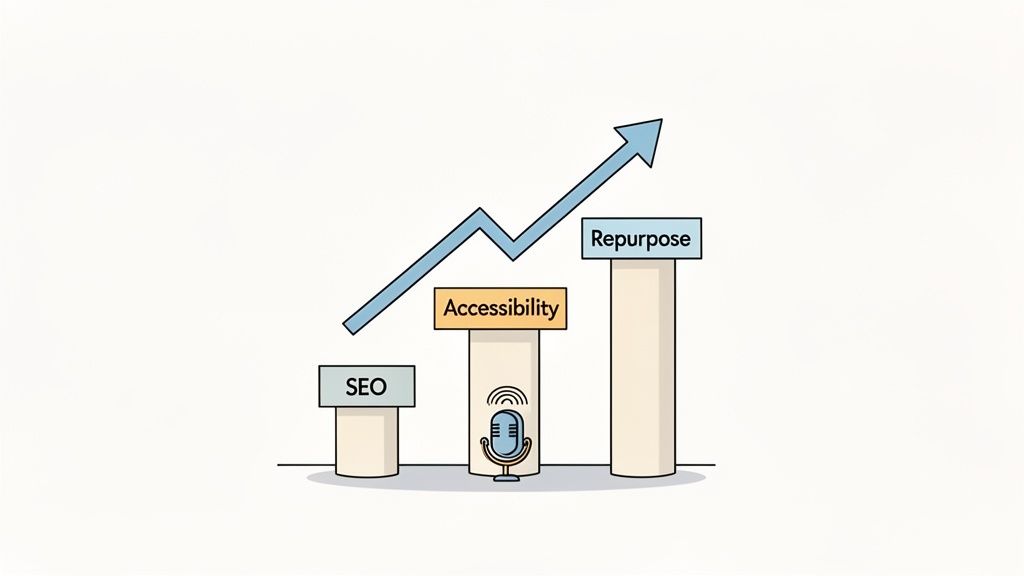
A podcast transcript is a powerful growth tool. Stop thinking of your podcast as just an audio file. Transcripts unlock four key opportunities: Google discovery, accessibility, content creation, and listener connection.
These pillars build on each other, expanding your reach. If you skip transcripts, you are leaving growth on the table.
Supercharge Your SEO Visibility
Search engines read text, they do not listen to audio. This is the primary reason every podcaster needs transcripts. Without a text version, your audio content is invisible to search bots. A transcript changes that.
Each episode becomes a text-rich page that can rank for various search terms. A one-hour interview can contain thousands of words and hundreds of long-tail keywords. This is how new people find your show organically, long after you publish.
Widen Your Audience with Accessibility
Accessibility is a smart way to grow your audience. A transcript opens your show to people who could not enjoy it otherwise. This includes listeners who are deaf or hard of hearing.
Transcripts also help non-native speakers who prefer reading. They are perfect for people in noisy or quiet environments where playing audio is not an option. By adding a transcript, you make your show welcoming to a larger audience.
Maximize Your Content ROI
Creating a podcast takes time and energy. A transcript lets you get a massive return on that investment with little extra work. It is the raw material for a wide range of content.
Think of a single transcript as the source code for a content campaign. It's the most efficient way to scale content production without recording new material.
From one episode transcript, you can create multiple pieces of content:
- Social Media Posts: Pull the best quotes or stats for LinkedIn, X (formerly Twitter), or Instagram.
- Blog Articles: Expand on one topic from the episode into a full blog post to attract more search traffic.
- Email Newsletters: Use the top three takeaways for a valuable, concise newsletter.
- Lead Magnets: Bundle transcripts from a series into a downloadable PDF to grow your email list.
This strategy turns one piece of content into many, amplifying what you have already created.
How to Get a Podcast Transcript
Getting a transcript involves a trade-off: you can pick two out of three between fast, cheap, and accurate. Your priority will determine the best method for your show.
You have three main paths: do it yourself, use an AI service, or hire a professional.
Your Three Main Options for Transcription
Choosing a transcription method is a key part of your workflow. Here are the pros and cons of each approach.
- The DIY Method: This means you type everything yourself. The pro is that it's free. The con is that it takes a long time. Budget 4-6 hours of typing for every hour of audio. This is not realistic for regular publishing schedules.
- AI-Powered Transcription Tools: This is the most popular option. Services like Otter.ai or Descript use AI to convert audio to text in minutes. They are fast, affordable, and can achieve 90-95% accuracy with clear audio. We break down how to translate audio to text using these tools in another post.
- Professional Human Transcription: When you need maximum accuracy, hire a human. Professionals deliver 99%+ accuracy and can handle accents, jargon, and overlapping speakers. This is the gold standard but comes with a higher price and a slower turnaround.
Comparing Podcast Transcription Methods
This table compares the three primary transcription methods to help you decide.
| Method | Typical Cost | Turnaround Time | Accuracy Rate | Best For |
|---|---|---|---|---|
| Manual DIY | Free (your time) | 4-6 hours per audio hour | Up to 100% | Hobbyists with ample time or one-off projects. |
| AI-Powered Service | $0.15 - $0.50 / minute | 5-15 minutes | 90-95% | Most podcasters, content repurposing, show notes, SEO. |
| Professional Human | $1.25 - $2.50+ / minute | 24-48 hours | 99%+ | Legal needs, academic use, accessibility (ADA), premium content. |
The right choice depends on your intended use for the transcript.
Which One Should You Choose?
Consider your end goal. If you need quotes for social media or a blog post, the speed and low cost of AI are perfect. A few typos are easy to fix.
If the transcript is for legal purposes, accessibility, or a paid course, invest in a human. Near-perfect accuracy protects your credibility.
A powerful workflow is a hybrid approach. Start with a fast, cheap AI transcript. Then, have a human editor give it a final polish.
This provides the speed of a machine with the quality assurance of a human. For those who lack time to read a full transcript, tools like PodBrief are the solution. We use AI to summarize key takeaways and action items, delivering value in minutes.
Best Practices for Publishing Your Transcripts
You have a transcript. Now what? Publishing a raw text file is ineffective. You must format and publish it with a clear strategy to get real value.
Your goal is to turn a wall of text into a readable, scannable, SEO-friendly asset. If a visitor sees a dense block of text, they will leave. Your formatting choices directly impact readability and engagement.
Core Formatting Essentials
A clean, easy-to-follow transcript is non-negotiable.
- Speaker Identification: Clearly label who is speaking. Use Host: or Guest Name: in bold before their lines.
- Timestamps: Add clickable timestamps at key moments. This lets people jump to a specific spot in the audio.
- Subheadings: Break up long conversations with descriptive subheadings. This helps readers scan and gives search engines a clear content map.
This decision tree visualizes the trade-offs when choosing a transcription method.
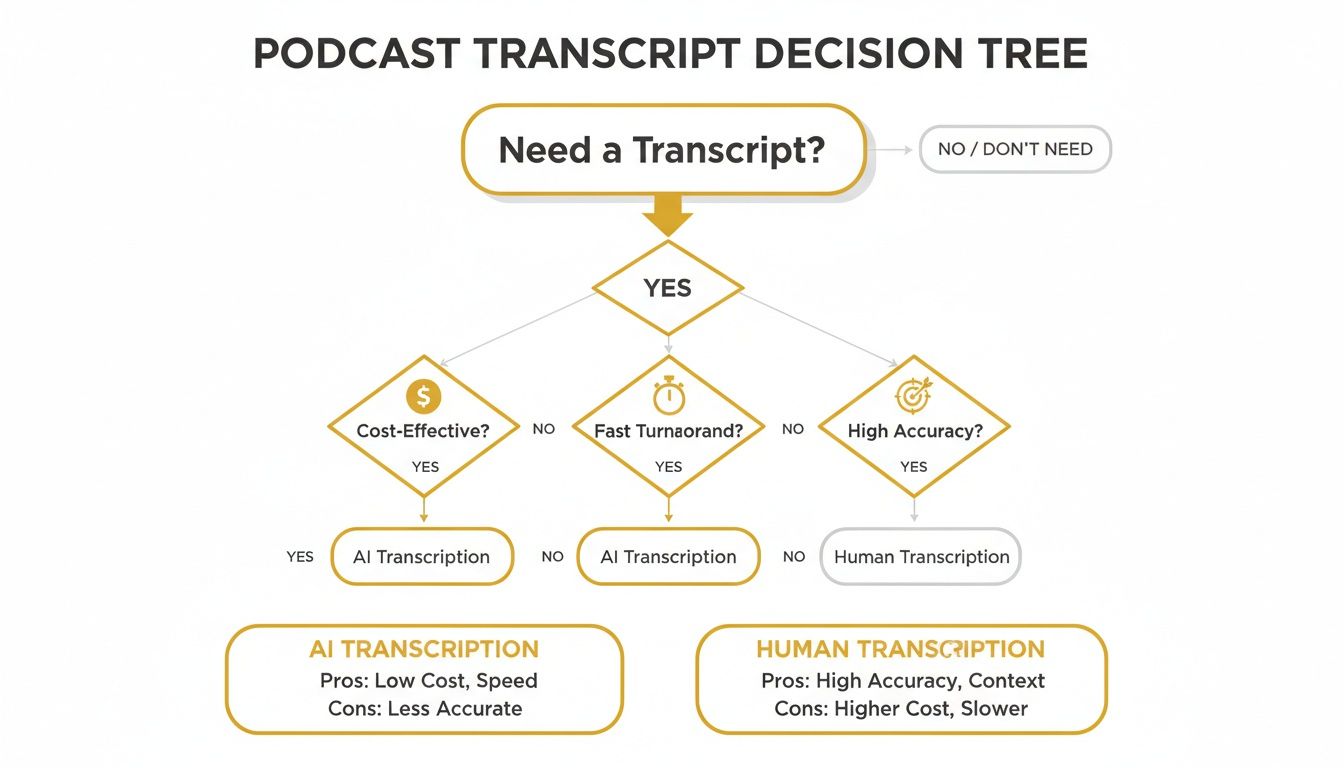
As you can see, AI is fast and cheap. If you need near-perfect accuracy, human services deliver at a higher cost and slower speed.
Where to Publish Your Transcript
Where you place your transcript impacts its SEO power and audience interaction. You have two main options.
1. On a Dedicated Blog Post This is the best option for maximizing SEO. A separate blog post gives Google a unique, keyword-rich page to index. You can optimize the title, meta description, and subheadings to attract new listeners from search engines.
2. Within Your Show Notes Putting the transcript in your show notes is convenient but less powerful for SEO. Search engines may give less weight to content hidden in an expandable section. See how major platforms handle this in our guide on Spotify podcast transcripts.
The winning strategy? Do both. Publish the full transcript as a blog post for maximum SEO. Then, link to that post in your show notes. You get the full search benefit and make it easy for listeners to find.
By formatting for people and publishing for search engines, you turn a simple document into a powerful growth tool.
Integrating Transcripts into Your Content Workflow
A podcast transcript is the source of truth for your content strategy. Successful teams weave it into their workflow to create new assets. This turns one recording into a multi-channel campaign.
Think of your transcript as raw clay. Your team can pull quotes for social media, create audiograms, or expand ideas into blog posts. This process multiplies your content output without more recording time. It is the most efficient way to maintain a consistent presence on all platforms.
From Raw Text to Actionable Intelligence
Internally, a transcript is a valuable research tool. A producer can use text search to find a specific quote, track topic mentions, or verify a statistic. This cuts down on fact-checking and preparation time.
However, we live in a world of information overload. Listener drop-off can hit 70% before an episode ends, often due to lack of time. A 10,000-word transcript is not a practical solution for a busy executive.
The Next Step: AI-Powered Briefs
The modern workflow requires a better solution. For professionals who need core insights without the fluff, the next step is an AI-powered summary.
This is what PodBrief was built to do. Our platform takes a dense podcast transcript and transforms it into an actionable summary. It delivers the most important takeaways and key ideas directly to you. It's the ultimate efficiency hack. You can learn more about how to turn a podcast transcript into an executive summary in our detailed guide.
Ready to stop reading and start knowing? Try PodBrief for free and see how AI can deliver the essential intelligence from any podcast.
Got Questions About Podcast Transcripts? We've Got Answers.
Here are answers to the most common questions about podcast transcription.
Are Podcast Transcripts a Big Deal for SEO?
Yes, a massive one. Google cannot listen to your podcast, but it can read. Without a transcript, your audio content is invisible to search engines.
A transcript for your podcast is a map for Google, full of keywords people are searching for. It is a powerful way to attract organic traffic and connect with new listeners.
What's the Difference Between Show Notes and a Transcript?
They are different tools that work best together.
Show notes are a summary. They give listeners a quick overview, highlight guests, and link to resources.
A transcript is the complete, word-for-word text of the episode. It unlocks the full benefits of SEO, accessibility, and content repurposing.
Pro Tip: Put a summary in your show notes and link to the full transcript on its own page. This gives you the best of both worlds and maximizes SEO.
How Perfect Does My Transcript Need to Be?
It depends on its purpose.
- For internal use? An AI-generated text with 90-95% accuracy is usually sufficient for finding quotes or researching topics.
- For public use? If it is on your website or used for accessibility, aim for 99%+ accuracy. No exceptions.
A sloppy transcript can look unprofessional. To hit that higher standard, use a human to edit the AI version or hire a professional transcription service.
Can AI Really Summarize a Transcript for Me?
Absolutely. It is the smartest way for busy people to get value from long-form audio. AI tools can distill a full transcript into concise summaries, pinpoint takeaways, and pull out actionable ideas.
This is exactly what PodBrief was built for. It takes a long transcript for a podcast and turns it into a sharp, executive-level brief. You get all the intelligence without reading every word. It's the final step in turning audio into action.
Stop drowning in full-length podcast episodes. PodBrief takes any transcript and delivers a concise, five-minute AI brief with all the key insights. Get the intelligence without the time commitment. Start your free trial at podbrief.io today.


