When people ask what is multimodal learning, they usually mean one of two very different things. They might mean a student learning through text, audio, images, and hands-on practice. Or they might mean an AI system that can process text, images, audio, and video together.
That split causes real confusion. A review of the topic from WorkRamp notes that searches for the term yield over 80% educational content, leaving less than 20% explaining the AI side. The same source says this gap leaves people underserved on how multimodal AI is tied to a 150% surge in edtech adoption (WorkRamp on multimodal learning).
The Two Meanings of Multimodal Learning
Multimodal learning has a human meaning and a machine meaning. If you mix them up, the whole topic gets blurry fast.
In education, multimodal learning means teaching and learning through more than one channel. A student might read a short passage, hear an explanation, look at a diagram, and then act out the idea or apply it in a task. The point is simple. The learner gets more than one way to understand the same concept.
In AI, multimodal learning means a model can work across different kinds of data at the same time. Instead of only processing text, it can also connect text with images, audio, or video. That lets a system interpret richer inputs, such as a lecture video with spoken explanations, slides, and on-screen demonstrations.
Bottom line: one meaning is about how people learn. The other is about how machines process information.
The useful insight is that these two meanings are no longer separate. AI systems that understand multiple formats can now help people study better by turning one form of content into another. A long podcast can become a written summary. A dense video lecture can become searchable notes. An audio explanation can become a study prompt.
That bridge matters for students, educators, and working professionals. The old question was, “Should I read, watch, or listen?” The better question now is, “How do I combine formats so I understand faster and remember more?”
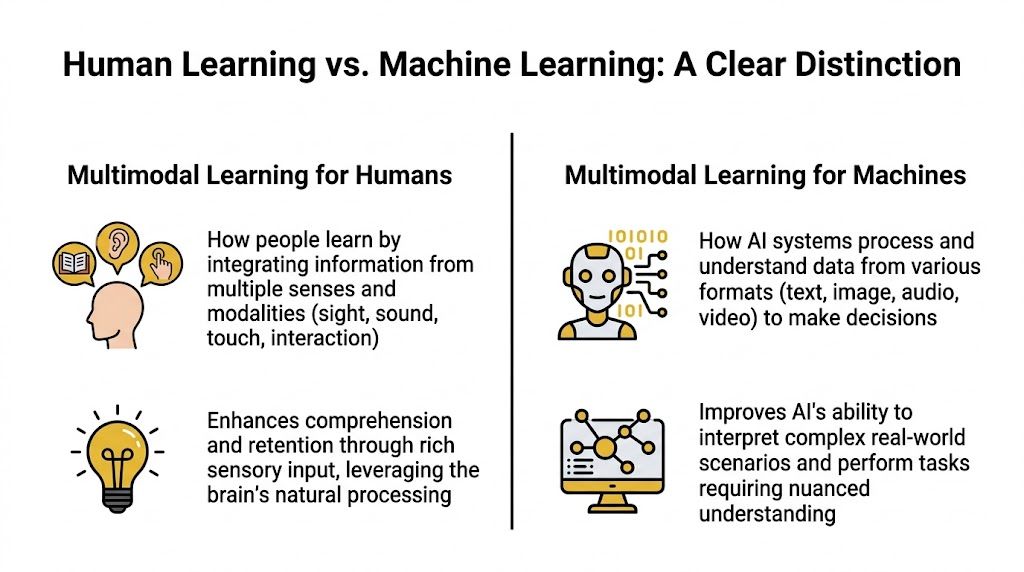
Human Learning vs Machine Learning A Clear Distinction
Some confusion disappears once you put the two definitions side by side.
Multimodal learning for humans
For people, multimodal learning means using several modes to support one learning goal. Those modes often include:
- Visual input such as charts, diagrams, sketches, timelines, or demonstrations
- Auditory input such as lectures, conversation, discussion, or recorded explanations
- Reading and writing such as articles, note-taking, reflection, or summarizing
- Kinesthetic activity such as movement, building, acting, pointing, sorting, or hands-on practice
Imagine using multiple handles to lift one heavy idea. If a concept is hard to grasp through words alone, an image can clarify it. If an image still feels abstract, a physical action or example can make it concrete.
A science teacher might explain moon phases verbally, show a visual model, ask students to label a diagram, and then have them move objects under a lamp to recreate the pattern. That's multimodal learning in the educational sense.
Multimodal learning for machines
For AI, the word means something else. The machine isn't “learning” through senses the way a human does. It's combining different data types so it can make better predictions or produce better outputs.
Examples include systems that work across:
- Text and image for captioning a photo or answering questions about a chart
- Audio and text for speech recognition and summary generation
- Video, audio, and text for understanding lectures, interviews, or presentations
- Cross-modal retrieval where one format helps find information in another
The plain-language analogy is this. A human learner uses more than one doorway into an idea. A multimodal AI uses more than one stream of evidence about the same input.
A simple comparison
| Human multimodal learning | Machine multimodal learning |
|---|---|
| Helps a person understand and remember | Helps a model interpret and generate outputs |
| Uses senses and activities | Uses data formats and model architectures |
| Example: read a poem, hear it aloud, annotate it, perform it | Example: analyze transcript, audio, and video frames together |
| Goal: stronger comprehension | Goal: stronger task performance |
Human multimodal learning is about instruction and memory. Machine multimodal learning is about data fusion and prediction.
The machine-learning side can get technical quickly, but the core idea is straightforward. According to the Wikipedia overview of multimodal learning, multimodal AI integrates formats such as text, images, audio, and video, often using approaches like cross-attention. The same overview notes that systems like CLIP can outperform unimodal models, and that in summarization tasks, fusing audio transcripts with other data can improve ROUGE-L scores by 10-20% over text-only approaches.
That technical advantage matters because many real learning materials aren't single-format anymore. A podcast has speech, tone, pacing, and context. A lecture video includes spoken language, visuals, and on-screen text. If an AI can read all of that together, it can build better study outputs than a text-only system.
The Research-Backed Benefits for Your Brain
The educational version of multimodal learning isn't just a trendy teaching term. It has strong support when it's used to reinforce a concept across channels.
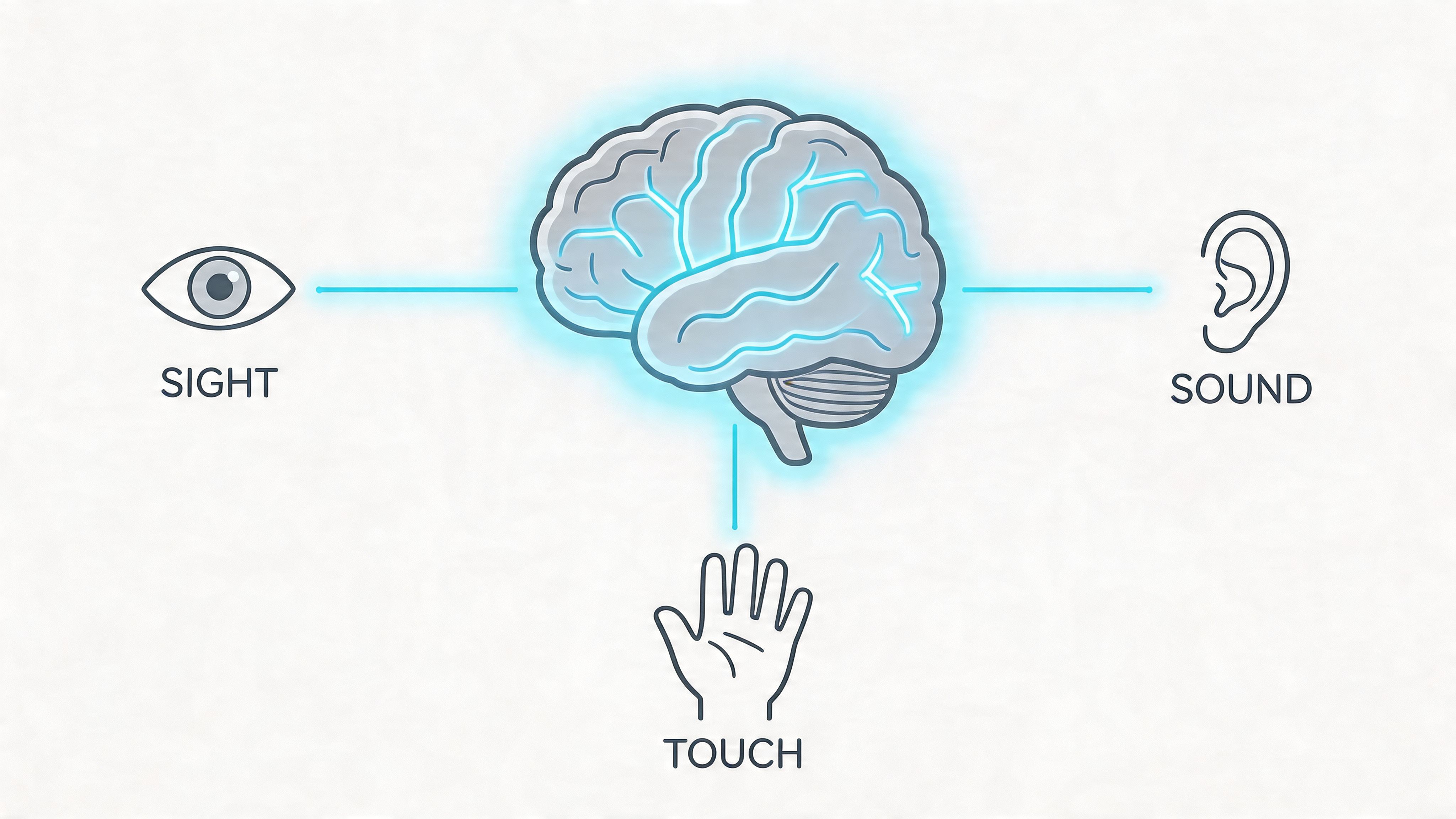
A 2022 Edutopia summary of multimodal learning research reports that a meta-analysis of 183 studies found that pairing words with physical actions had an effect size of 1.23, which researchers classify as a large impact on learning. The same source reports that 8-year-olds achieved 73% better recall in language learning when they used their hands and bodies to mimic words.
That doesn't mean every lesson needs movement, props, and five apps. It means your brain tends to remember better when the same idea is encoded through more than one route.
What actually helps
The strongest version of multimodal learning is not “pick your learning style and stay there.” That claim gets overstated. The better-supported idea is that multiple forms of input can reinforce one another.
For example:
- Read a short explanation of a concept
- Look at a diagram or worked example
- Explain it aloud in your own words
- Do a quick practice task or gesture-based recall exercise
Each step adds another retrieval path. When you later try to remember the concept, your brain has more than one cue to work with.
The gain doesn't come from labeling someone a visual learner or auditory learner. It comes from giving the brain multiple, well-aligned ways to encode the same idea.
Why this works in practice
A single format can leave a concept thin. Reading alone may explain the logic, but not the shape. Audio alone may capture tone, but not structure. A hands-on task can expose gaps that passive review hides.
Multimodal teaching also helps with abstract material. Fractions, grammar rules, anatomy, and systems thinking often become clearer when learners can see, hear, and manipulate the idea.
Here's a practical rule educators can use:
- Match modes to the concept. Use diagrams for relationships, spoken explanation for nuance, writing for synthesis, and physical activity for sequence or process.
- Keep the modes aligned. Every format should support the same objective, not distract from it.
- Use repetition with variation. Revisit the same idea in different forms instead of piling on unrelated media.
Practical Multimodal Strategies You Can Use Today
Good multimodal learning doesn't require expensive tools. It requires deliberate mixing of formats around one goal.
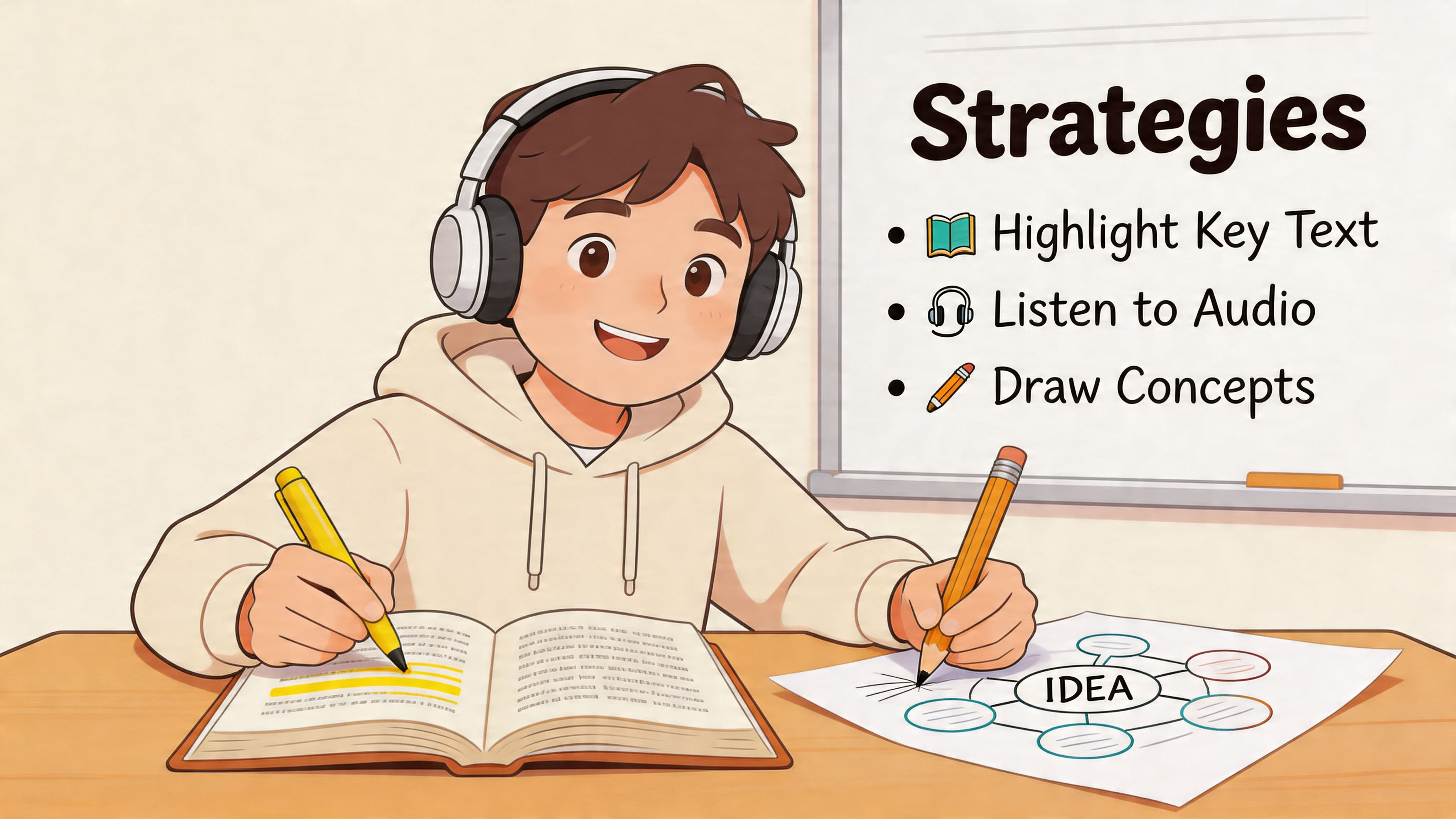
For self-learners
If you're studying on your own, start small and stack formats instead of replacing one with another.
- Turn notes into visuals. Convert a page of notes into a mind map, flowchart, or comparison grid. This forces you to organize ideas, not just copy them.
- Read, then explain aloud. After reading a section, close the page and teach it back to yourself in plain language.
- Use audio on purpose. Listen to a lecture, podcast, or text-to-speech version of material you've already seen in writing. The second mode often reveals what you missed the first time.
- Add movement to recall. Walk while reciting steps, point to parts of a diagram, or use hand motions for sequences and categories.
- Create a short synthesis. Write three takeaways and one question after each study session.
If you work with spoken content often, this guide on how to process information faster from audio pairs well with a multimodal study routine.
For teachers and trainers
Instruction improves when you plan the learning objective first and the formats second.
- Open with a concrete visual. Start with a chart, image, model, or short example before giving a full explanation.
- Teach with dual input. Speak while showing a simple visual, but keep both tightly connected.
- Build in active response. Ask learners to sort, label, sketch, discuss, or demonstrate, not just listen.
- Use short reflection cycles. After instruction, ask for a written summary, partner explanation, or quick application task.
- Vary output, not standards. Let learners show understanding through writing, speaking, diagramming, or demonstration while holding the same bar for accuracy.
A short classroom-focused explainer can help teams see the pattern in action:
Practical rule: don't add modes for decoration. Add them when they make the idea easier to grasp, apply, or remember.
One easy weekly pattern
Try this five-part rhythm for any topic:
- Preview with a visual or short summary
- Learn through reading or listening
- Discuss by teaching it back
- Apply in a task, example, or problem
- Review with a compact written recap
That's multimodal learning in a form that is sustainable for learners.
How AI Turns Content into Multimodal Study Aids
A useful connection exists between the two meanings. AI can process multimodal content, then reshape it into materials that help humans learn multimodally.

A lecture video isn't just “video.” It may contain speech, pacing, emphasis, slide text, diagrams, and scene changes. A podcast isn't just “audio.” It carries structure, transitions, tone, and repeated themes. A multimodal AI model can combine those signals and produce something more useful than a raw transcript.
That matters because transcripts alone are often messy. Spoken language loops, repeats, and wanders. A stronger system can use more than one cue to decide what matters most.
What the AI is doing
At a high level, multimodal AI for study support can:
- Ingest speech from audio or video
- Convert speech to text for searchable analysis
- Use additional context from visuals or formatting cues when available
- Compress key ideas into summaries, takeaways, and structured notes
- Repackage the material into formats people can skim, revisit, and review
The result is a better bridge between long-form content and actual learning.
If you want to understand the value of transcript quality in that workflow, this article on podcast transcripts and how they support learning workflows is a useful companion.
Why this helps real learners
AI doesn't replace study. It improves the starting point.
A student can go from a one-hour interview to a concise summary, then annotate the summary, discuss it, and use it for retrieval practice. A manager can extract key points from a training video, turn them into action items, and revisit them later. A researcher can scan ideas across multiple episodes before deciding what deserves a full listen.
The broader ecosystem is moving this way too. Resources such as AI Powered Revision show how revision tools increasingly convert complex source material into more usable learning formats.
The best use of AI in learning is not to do the thinking for you. It's to reduce friction so you can spend more time on understanding, retrieval, and application.
The Future of Learning is Combined Intelligence
The most useful answer to what is multimodal learning is no longer one definition. It's a partnership.
People learn better when they engage ideas through more than one mode. AI systems perform better when they can interpret more than one kind of input. When those two truths work together, learning gets faster, cleaner, and more practical.
For educators, that means designing lessons that mix explanation, representation, practice, and reflection. For learners, it means stopping the habit of relying on one format alone. For teams and organizations, it means building systems that turn meetings, podcasts, lectures, and videos into usable knowledge assets. If you're interested in the workplace side of that shift, AI is transforming corporate training offers a helpful look at how training is changing.
One more habit is worth building: use tools that help you move across formats, not stay trapped in one. This roundup of AI tools for podcast listeners is a practical place to start if audio content is part of your learning routine.
The old model was passive consumption. Read it once. Listen once. Hope it sticks.
The better model is active conversion. Turn content into summaries, notes, questions, visuals, and discussion points. Then use those outputs to think.
If you want a faster way to turn podcasts and videos into study-ready takeaways, try PodBrief for free. It converts long-form audio and video into concise briefs you can read or listen to, which makes it easier to review ideas, build notes, and learn without replaying hours of content.